Decoding the digital age
Star Citizen and the Billion-Dollar Problem of Never Finishing
Cloud Imperium has raised more than $1 billion in community funding for Star Citizen and Squadron 42, but its flagship multiplayer game remains unfinished almost 14 years after its announcement. What is going wrong?

Games
Star Citizen and the Billion-Dollar Problem of Never Finishing
Cloud Imperium has raised more than $1 billion in community funding for Star Citizen and Squadron 42, but its flagship multiplayer game remains unfinished almost 14 years after its announcement. What is going wrong?
Image: Cloud Imperium Games
In a Word...
- Star Citizen is a substantial playable space simulation, but remains in alpha almost 14 years after its announcement.
- Its crowdfunding model gave Cloud Imperium extraordinary creative freedom while weakening the normal pressures to control scope and reach a finished release.
- Squadron 42 demonstrates the project’s genuine talent and ambition, but its latest delay also illustrates why confidence in Cloud Imperium’s schedules has deteriorated.
- Players have financed the company like investors while retaining only the limited influence of customers.
The end came slowly and painfully. After nearly two hours of lag, glitches, failed weapons and strained conversation, the Cloud Imperium developers attempting to complete Star Citizen’s Siege of Orison event were running out of time.
The livestream on 5 August had been intended to demonstrate a cooperative game in the company’s long-awaited space simulation. Instead, the team struggled with desynchronisation and sluggish combat while playing an internal build on a private server. Eventually, the entire group was killed. Jared Huckabee, Cloud Imperium's content director, appeared behind the presenter Oliver Hull and told him they were out of time and should finish the show.
The technical failures were only part of the problem. The presenters repeatedly talked over one another, jokes landed badly and the team sometimes looked uncomfortable. Exchanges that might have passed unnoticed during a successful broadcast appeared harsher as the mission disintegrated around them. A showcase of cooperative play had begun to resemble a demonstration of organisational dysfunction.
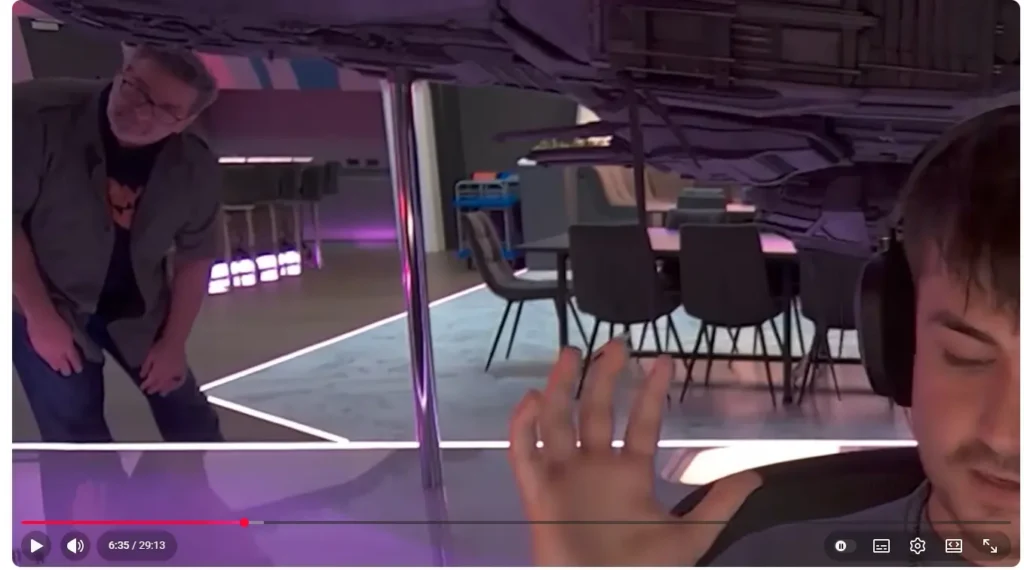
One livestream cannot establish that Cloud Imperium has a toxic culture. Live broadcasts create pressure, colleagues can misjudge each other’s humour and viewers inevitably interpret awkward moments through what they already believe about the company. Yet the stream was damaging because it appeared to compress the Star Citizen story into a single event: enormous ambition, visible technical achievement, genuine effort and a continuing inability to make the whole thing work reliably when required.
After almost 14 years and more than $1 billion in community funding, the usual explanations are becoming harder to sustain. The important question is no longer whether Cloud Imperium has built anything. It plainly has. It is whether the project’s unusual structure has made eternal development much easier than completion.
What is Star Citizen?
Star Citizen is difficult to describe because it is no longer a single, clearly bounded game. At its centre is a persistent online universe combining space flight, trading, mining, exploration and ship combat with first-person shooting, survival mechanics and planetary environments.
Parts of this experience can indeed be remarkable. Players can wake in a city, travel through a functioning public transport system, reach a spaceport, enter a highly detailed ship and fly seamlessly from the planet’s surface into space. Larger vessels contain physical interiors in which other players can move around while the ship is travelling. Cargo can be loaded, components repaired and battles fought on foot or in the cockpit.
These experiences explain why the project retains devoted supporters. Few games attempt this combination of scale, physical detail and continuity, and fewer still combine seamless spaceflight with traversable ship interiors and meaningful multicrew activity.
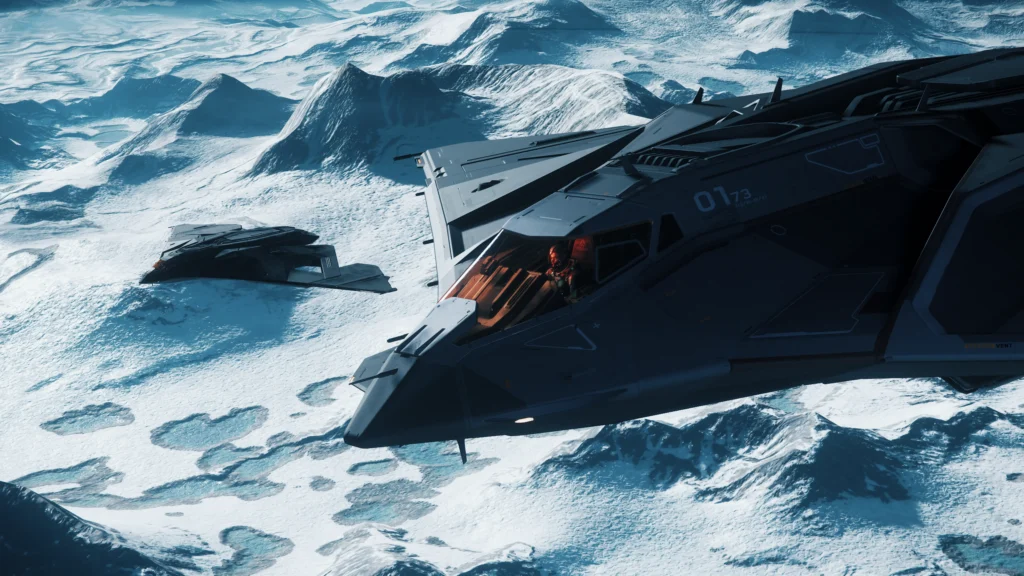
But Star Citizen remains in alpha. Its systems are incomplete, performance can be erratic and glitches can destroy the elaborate sense of presence the game works so hard to create. Elevators, inventory systems, doors, mission triggers and non-player characters have all become recurring sources of frustration. The experience can move from a convincing science-fiction world to a stressful, session-ending bug without warning.
Alongside the persistent universe sit more contained modes: Arena Commander provides ship combat and racing, while Star Marine concentrates on first-person action. These modes have allowed Cloud Imperium to test mechanics and give backers something playable, but they have also contributed to the project’s fragmented identity. Star Citizen exists simultaneously as a game, an alpha test, a development platform and a promise of the much larger universe still to come.
Leslie Benzies’ Build A Rocket Boy pursued another vision that combined a game with a much larger creation platform, but MindsEye faced a very different test when it launched as a standalone commercial release.
What is Squadron 42?
Squadron 42 is the project’s separate single-player campaign. It uses much of the same technology but offers a more conventional, authored experience built around military service, space combat and first-person missions.
Its CitizenCon 2024 gameplay demonstration deserves serious credit. The hour-long prologue combined detailed ship interiors, large-scale space warfare and cinematic sequences with on-foot action. Even allowing for the controlled nature of a public showcase, it looked genuinely impressive.
The campaign also contains an unusually prominent cast. Gary Oldman, Mark Hamill, Gillian Anderson, Henry Cavill, Andy Serkis, Mark Strong, Ben Mendelsohn, John Rhys-Davies and Liam Cunningham are among the actors involved. Their presence adds glamour and may help Squadron 42 appeal beyond the existing Star Citizen community.
However, performance capture, intricate cinematics and major acting talent inevitably add production complexity. There is no public breakdown showing how much individual performers were paid, and it would be misleading to suggest that celebrity fees explain anything close to the billion-dollar total. The cast matters because it illustrates a wider tendency. Faced with several possible versions of a space game, Cloud Imperium has repeatedly chosen the most expansive and prestigious one.
The quality of the 2024 presentation complicates the easy allegation that Star Citizen is vapourware. Cloud Imperium has produced substantial technology, artwork and playable material. Squadron 42 may eventually become an excellent game. The difficulty is turning that potential into a product customers can actually buy and complete.
How Much Money has Star Citizen Raised?
The project began on a much smaller scale. Its 2012 Kickstarter sought $500,000 and raised just over $2.1 million from more than 34,000 backers. Additional funding through Cloud Imperium’s own website brought the combined early total above $6 million. Notably, the campaign’s original timetable anticipated delivery in November 2014.
The proposition was certainly attractive. Chris Roberts, creator of Wing Commander and the original driving force behind Freelancer, promised to revive a kind of ambitious PC space simulation that major publishers seemed reluctant to fund. Supporters would help establish demand while allowing the developers to avoid corporate interference.
Success changed the nature of the project. New funding targets brought new ships, locations and systems. The increased resources did not simply make the original design more secure. They enlarged it. A campaign that had initially demonstrated enthusiasm for a space game became an open-ended mandate to construct an unprecedented virtual universe.
With Roberts still at the helm, Cloud Imperium announced that lifetime community funding had passed $1 billion in June 2026. This is a cumulative figure covering Star Citizen and Squadron 42. It is not a billion dollars sitting in a bank account, nor does it represent a clean measure of development expenditure. Money has flowed into salaries, contractors, infrastructure, publishing, offices, servers, events and the continuing operation of the playable alpha.
The distinction matters, but it does not make the total unimportant. Few entertainment projects have received this level of direct customer financing before release. With that money came an exceptional responsibility to control scope and provide a credible route to completion.
Why Has Star Citizen Taken so Long?
In truth, there is no single explanation. The project combines several of the most difficult forms of game development: a persistent multiplayer universe, detailed vehicle simulation, an economic sandbox, a first-person shooter and a cinematic single-player campaign.
Cloud Imperium has developed much of the project’s underlying technology while simultaneously building the games that depend on it. The resulting technology, branded StarEngine, evolved from CryEngine, which the project used at the start of development. Cloud Imperium later moved to Amazon’s CryEngine-derived Lumberyard framework before modifying the technology extensively to meet Star Citizen’s unusual technical demands.
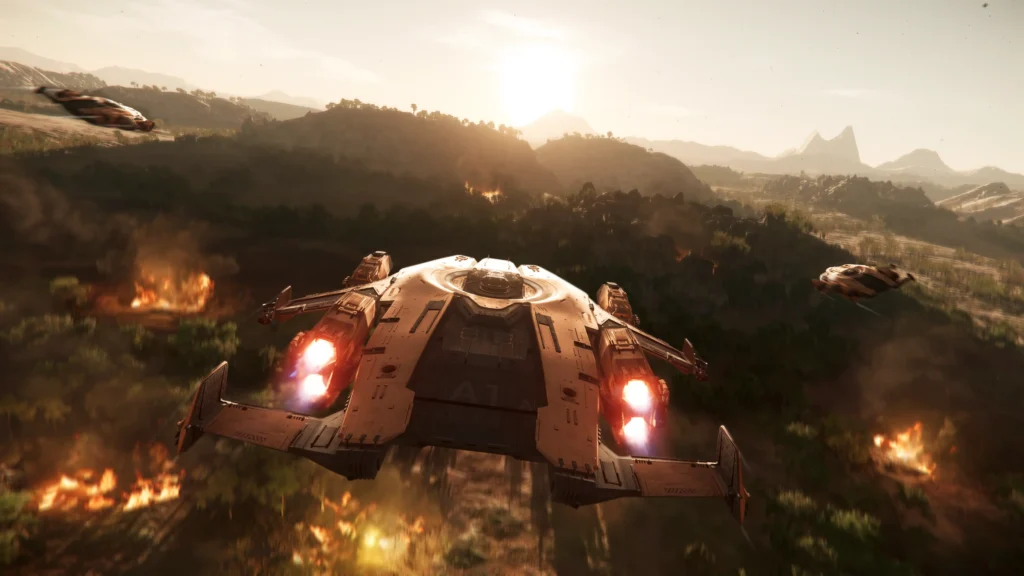
Some of the engineering challenges are real and unusual. Persistent Entity Streaming is intended to preserve the state and location of objects across a huge environment. Server meshing distributes the universe across multiple servers while attempting to keep the boundaries invisible to players, and planetary technology must support travel across enormous environments without conventional loading screens.
These systems represent genuine technical work, but they also reveal the risks of conducting foundational research, engine development and content production simultaneously. Cloud Imperium’s internal decision-making remains largely opaque, yet the pattern suggests a cycle in which each breakthrough enables greater ambition, while each delay creates an opportunity to revisit systems developed years earlier. Star Citizen may therefore be caught in a development trap: it must keep advancing technologically even as its destination continues to move.
Star Citizen: Development Timeline
| Year | Development Milestone | Why It Matters |
|---|---|---|
| 2012 | The original Kickstarter raises more than $2.1 million | The campaign establishes demand for an ambitious, independently produced space simulation |
| 2013 | Cloud Imperium begins releasing early playable modules to backers | The project begins evolving from a conventional game release into an extended process of open development |
| 2014 | The original anticipated delivery window passes | Increased funding and expanding scope have already transformed the original production timetable |
| 2015 | The first version of the Persistent Universe becomes available to backers | Players can begin experiencing the foundations of the planned online universe |
| 2018 | The Calder family office and Snoot Entertainment invest $46 million | The deal brings conventional equity investment and outside board representation into the company |
| 2020 | Existing investors contribute another $17.25 million | Publicly announced private investment reaches $63.25 million |
| 2023 | Cloud Imperium declares Squadron 42 feature-complete | The single-player campaign enters its polishing and optimisation phase |
| 2024 | An hour-long Squadron 42 prologue is demonstrated at CitizenCon | The presentation provides the clearest evidence yet of a substantial and visually accomplished campaign |
| 2026 | Community funding passes $1 billion across Star Citizen and Squadron 42 | The project reaches an unprecedented funding milestone while Star Citizen remains in alpha |
| 2027 | Current target for the release of Squadron 42 | A successful release would be Cloud Imperium’s first completed flagship product |
Organisational scale creates another difficulty. Cloud Imperium grew from a crowdfunding campaign into an international developer employing more than 1,000 people. Coordinating multiple studios and hundreds of interdependent specialists requires disciplined production management as much as creative vision.
Roberts’ background and persona are central to this. His career demonstrates a rare ability to persuade others that space games can be more elaborate, cinematic and immersive than the industry conventionally permits. It is reasonable to identify the corresponding risk: difficulty deciding when the vision has become large enough.
How Does Star Citizen Make Money?
Cloud Imperium continues to raise money through starter packages, subscriptions, digital items and ships. Some vessels cost hundreds of dollars, while limited offers for capital ships can pass $1,000. In 2026, coverage of the project’s funding milestone highlighted a concept ship offered for $5,000 before it was available to fly.
It is worth noting that players are already engaging with the game. One unofficial estimate puts its monthly active audience at around 400,000. Many supporters also understand that they are not making ordinary retail purchases. They may be funding development, acquiring status within the community or buying into the imagined future of the universe.
Expensive ships are therefore not necessarily evidence of deception. They do, however, create a powerful incentive for the company.
A new ship is visible, marketable and capable of generating revenue immediately. Infrastructure work, performance improvements and bug fixes are essential but difficult to sell as discrete objects. This does not mean that vehicle artists could simply be reassigned to networking or server engineering. Large development teams contain specialised roles that are not interchangeable.
The issue operates at the level of the organisation. Cloud Imperium’s funding model places an immediate commercial value on expanding the universe, while providing no equivalent short-term reward for reducing its scope.
The company’s own figures demonstrate how effective this model remains. In 2024, pledges and sales generated $116.3 million, despite falling slightly from the previous year. Subscriptions contributed another $7.3 million.
Continued development is therefore not simply a period of expense before the business begins. It is already the basis of a functioning commercial system. New ships and features sustain interest; interest generates funding; funding supports a large organisation; and that organisation creates more ships, systems and promises.
A company can be engaged in real development while becoming structurally dependent on development continuing.
Where Has the Star Citizen Funding Gone?
The available figures reject the idea that Cloud Imperium has raised $1 billion and produced nothing. Its 2024 accounting reported 1,031 employees at the end of the year, including 695 working directly in development. Salary and related costs reached $71.4 million.
Total income for the year was $146.6 million. Trading costs were $152.9 million, rising to approximately $161 million once capital expenditure was included. On Cloud Imperium’s presentation, spending exceeded income by $14.3 million once capital expenditure was included.
The money has supported a large international workforce, external specialists, servers, publishing operations, performance capture, technology development and the continuing operation of Star Citizen as a live alpha. Cloud Imperium has not made its billion dollars disappear into an empty shell.
The offices themselves, however, still deserve scrutiny. In 2022, the company spent $12.9 million on capital expenditure, principally associated with its Manchester and Frankfurt facilities. Cloud Imperium described them as “destination” workplaces designed to encourage staff to return to the office. Its Manchester headquarters contains extensive game artwork, atmospheric lighting and science-fiction styling.
Cloud Imperium’s 2024 Income and Spending
| Category | What It Includes | 2024 Figure |
|---|---|---|
| Income | ||
| Pledges and sales | Starter packages, spacecraft, digital items and concept-ship pledges | $116.3m |
| Subscriptions | Recurring income from the existing community | $7.3m |
| Other income | Development incentives, tax credits, partnerships, vendor income and third-party Turbulent work | $23.0m |
| Total income | Total company-reported income for the year | $146.6m |
| Spending | ||
| Salaries and related costs | Employee costs excluding personnel counted under publishing, community and marketing | $71.4m |
| Studio and group overheads | Office rental, maintenance, travel, accommodation, IT and studio operations | $36.7m |
| Contracted game development | Specialist external work including motion capture, head scanning and music | $5.5m |
| Publishing, support and marketing | Servers, online infrastructure, customer support, publishing, community activity, events and marketing | $37.5m |
| General and administration | Insurance, accountancy, professional services and legal costs | $1.9m |
| Total trading costs | Company-reported operating expenditure before capital expenditure | $152.9m |
| Capital expenditure | Hardware, software, fixtures, offices, server upgrades and infrastructure | $8.0m |
| Total spending including capex | Trading costs plus capital expenditure | Approx. $161m |
| Shortfall after capex | Amount by which reported spending exceeded income | $14.3m |
Source:
Cloud Imperium Games’ 2024 accounting
.
Figures are rounded and describe the 2024 financial year, not the cumulative allocation of the project’s lifetime community funding.
These facilities do not explain the overall cost of Star Citizen. Employment and development spending are much larger. But the offices carry symbolic force. They show a company willing to build the elaborate headquarters of an established international studio before releasing either of its foundational products.
That decision may be defensible as an investment in recruitment and collaboration. It also reinforces the impression that Cloud Imperium has often treated expansion as evidence of progress, even when the relationship between organisational scale and finished output remained uncertain.
What Happens When there is no Publisher?
The original Star Citizen pitch presented freedom from publishers as an advantage. That judgement was not unreasonable. Publishers can cancel promising games, impose destructive deadlines and prioritise financial timetables over creative quality.
Crucially, they also impose limits.
A conventional publisher controls budgets, assesses milestones and asks whether new features justify their cost. It can reduce scope, demand management changes, withhold further funding or cancel a project. These interventions may be unwelcome, but they force a project to confront the difference between what its creators can imagine and what an organisation can deliver.
Roberts’ earlier game Freelancer provides an instructive precedent. Development expanded considerably beyond its initial plans before Microsoft acquired Digital Anvil. Roberts left operational control, the project was reduced in scope and Freelancer eventually appeared in 2003.
The finished game did not realise everything originally promised. Yet it existed. What could be remembered as corporate interference can also be understood as the discipline that converted an ambitious development project into a commercial product.
Duke Nukem Forever offers another comparison. As No Latency previously explored, this game's 14-year development became synonymous with feature creep, technological restarts and the promise that the game would arrive “when it’s done”. But its original developer eventually ran out of money. Publishing rights and development moved elsewhere, and another company completed the game.
Star Citizen’s customers cannot perform the same function. Backers can obtain cash refunds within 30 days of an order and can reclaim eligible pledges for non-refundable store credit. Beyond that, they can stop spending individually, but possess no general mechanism for withdrawing their accumulated financial support, reducing the project’s scope, demanding leadership changes or imposing a deadline.
Why Was Squadron 42 Delayed Again?
Squadron 42 had been expected during 2026. It has now moved to the second quarter of 2027.
In his latest Letter from the Chairman, Roberts said Cloud Imperium wanted to avoid releasing into the media “attention buzz saw” surrounding Grand Theft Auto VI. With Rockstar’s game scheduled for November 2026, the commercial logic is plausible. GTA VI is likely to dominate games coverage and consumer attention on a scale few releases could withstand.
But Cloud Imperium’s history makes that explanation difficult to accept without qualification. Avoiding GTA VI may be sensible release management, but it is also unusually convenient for a studio whose deadlines have so often moved for less strategic reasons.
Squadron 42 nevertheless offers Cloud Imperium its clearest opportunity to change the story. Unlike Star Citizen’s expanding universe, it is an authored campaign with an ending. The 2024 footage suggests that something visually accomplished and technically impressive may emerge.
If Squadron 42 releases in 2027 and succeeds, it will demonstrate that Cloud Imperium can finally convert its talent and technology into a finished product. However, it will not erase the management questions created by the preceding 15 years.
Who is Accountable for Star Citizen?
Cloud Imperium has described its relationship with players as unusually open. The community receives development reports, demonstrations, test builds and opportunities to influence priorities. That openness has real value. But consultation is not governance.
Backers have financed Star Citizen like investors without receiving investor rights. They share the financial risk of an unfinished product, but not the power to examine management in detail, control budgets or demand changes in leadership. Their principal formal leverage is the decision not to spend again.
This should raise questions for companies intending to finance development through massive crowdfunding campaigns, but also for players themselves: what are they willing to spend money backing when they have so little leverage?
Who Else has Invested in Star Citizen?
Cloud Imperium is not financed exclusively by its players. In 2018, the family office of music-industry billionaire Clive Calder and Snoot Entertainment, run by his son Keith, invested $46 million for roughly 10 per cent of Cloud Imperium’s US and UK companies. Existing investors added another $17.25 million in 2020, bringing the publicly announced private investment to $63.25 million.
The distinction matters because these were equity investors, not backers. The original transaction gave the Calders board representation through their nominee, games lawyer Dan Offner, alongside a second new outside director, Eli Klein. It therefore introduced at least some of the conventional corporate oversight missing from Cloud Imperium’s relationship with its customers.
The limits of that oversight were explicit. Roberts said control of the company and its board remained firmly with him as chairman, chief executive and majority shareholder. Cloud Imperium had rejected private-equity and venture-capital approaches over concerns about short-term decision-making, presenting the Calders instead as patient, like-minded investors principally funding the marketing and release of Squadron 42.
The investment provides some external financial scrutiny, but gives the community no additional authority. A minority investor deliberately selected for alignment is not the same thing as a publisher empowered to impose a budget, cut features or enforce a release date.
A Weakness in the Funding Model?
This exposes the central weakness in Cloud Imperium’s model. A community can be remarkably effective at proposing features, reporting bugs and sustaining enthusiasm. It is much less well equipped to tell a charismatic founder that his vision must now become smaller. Crowdfunding can help an ambitious project expand; it offers few natural mechanisms for forcing that project to contract.
The August livestream mattered because, for a few uncomfortable hours, it interrupted Cloud Imperium’s usual control over the presentation. The audience did not see a polished trailer or a carefully staged technology demonstration. It saw developers struggling with their own game and, at times, with one another. That does not substantiate every allegation made about the company. But after almost 14 years of development, it cannot simply be dismissed as an unfortunate afternoon.
None of this requires Star Citizen to be a scam. The reality may be more complicated, and in some respects more troubling. Cloud Imperium has built real technology, a playable live product and a substantial international company. It has also created a system in which customers provide continuing finance without acquiring any of the power normally associated with continuing financial exposure.
Star Citizen’s strangest achievement is that it has survived long enough to become both a troubled game and a successful business. Cloud Imperium has effectively built a spacecraft that can keep travelling forever. Arrival is no longer relevant.