Decoding the digital age
AI SaaS Pricing Models: Why AI is Killing the Seat License
As AI computing costs collapse, traditional per-seat SaaS models are breaking, forcing software vendors to charge for automated outcomes rather than human users.

News Analysis
AI SaaS Pricing Models: Why AI is Killing the Seat License
As AI computing costs collapse, traditional per-seat SaaS models are breaking, forcing software vendors to charge for automated outcomes rather than human users.
In a word...
- A 900-fold drop in AI computing costs makes high-margin monthly subscription seat pricing completely unjustifiable.
- Companies are cutting human seats while automated AI agents create massive, unmonetized background workloads.
- To survive, SaaS vendors are shifting from user-based licensing to charging for completed outcomes.
For twenty years, the business model of software-as-a-service (SaaS) rested on a beautifully simple premise: more humans meant more seats (individual user accounts), and more seats meant more recurring revenue.
When generative AI arrived, the immediate threat to this model was obvious. If an AI tool allows two customer service agents to do the work of ten, a corporate buyer cancels eight seat licenses. The vendor’s revenue shrinks, even though the value delivered to the client stays flat or increases.
To defend against potential seat-count compression, major enterprise software vendors established rigid premium pricing tiers for their generative AI additions rather than absorbing them into baseline subscriptions. This defensive packaging strategy was largely pioneered by Microsoft, which established the industry's default pricing benchmark by imposing a flat Microsoft 365 Copilot Enterprise Pricing
fee of $30 per user, per month on top of existing baseline software licenses - a premium model that major SaaS competitors quickly duplicated to protect historical margins.
However, a secondary, structural wave is now hitting the tech economy, rendering that hedge entirely useless: the absolute collapse of raw AI computing costs.
Quick answer
Is AI breaking seat-based SaaS pricing?
- In some respects, yes. Seat-based pricing works when software value is tied to human users.
- AI agents change that logic by doing work in the background, often with fewer human seats but more automated usage.
- That pushes SaaS companies towards usage-based, outcome-based or hybrid pricing models.
The 99% AI Inference Cost Collapse
The missing link in the current SaaS conversation isn't how many human jobs AI will displace, it’s how little it costs to run the intelligence itself.
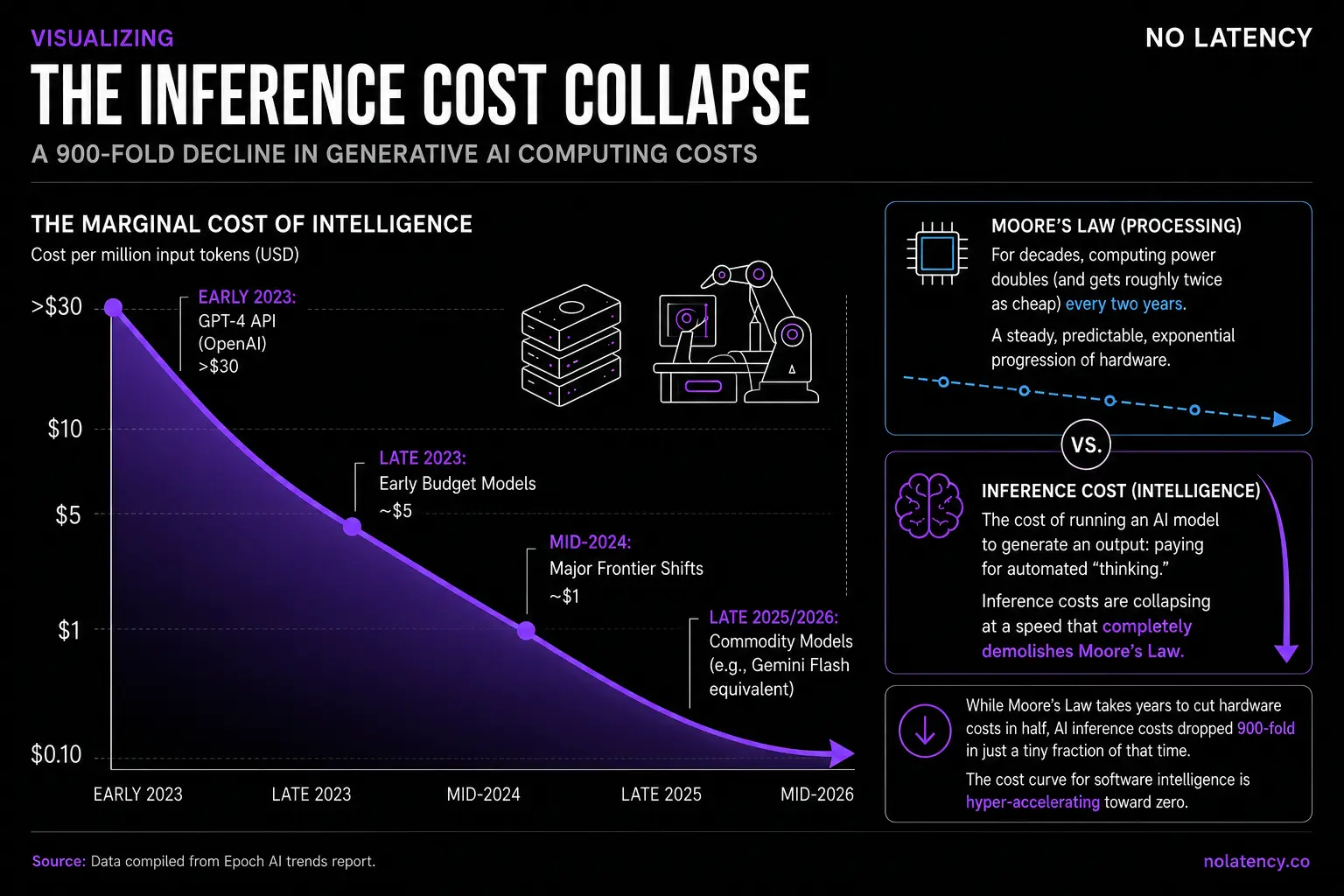
According to data compiled by Epoch AI, the inference cost, the price of running data through a trained model to generate an output, dropped roughly 900-fold across major frontier systems in a staggering multi-year decline.
To look at it in concrete terms: when OpenAI launched GPT-4’s API in early 2023, it cost $30 per million input tokens. Today, highly capable models of equivalent or superior performance cost pennies. Google’s budget-tier Gemini Flash models, for example, have driven costs down to fractions of a dollar per million tokens.
Inference Cost Collapse
The marginal cost of software intelligence is rushing toward zero faster than almost any computing commodity in human history, dramatically outstripping the historical trajectory of Moore's Law.
When the raw material of your core feature becomes a dirt-cheap commodity, you can no longer mask it inside a high-margin, flat-rate monthly subscription. This creates a brutal paradox for traditional enterprise software platforms, bringing them face-to-face with the value puzzle of how to price products when the cost of creation plummets but the utility to the buyer skyrockets.
As such, enterprise procurement teams are suffering from intense "AI seat fatigue." They are aggressively refusing to pay static, fixed premiums for every employee when actual utilization varies wildly.
The Shift from Seats to Autonomous AI Agents
Simultaneously, the nature of software usage is changing. Software is transitioning from a static tool that a human logs into, to an environment populated by autonomous, non-human agents executing background workflows.
Consider a real-world example tracked by The SaaS CFO: a modern enterprise team scaled down their human Salesforce footprint from over ten active users to just two human supervisors. However, those two humans deployed a fleet of over 20 autonomous AI agents that pinged the database constantly. Because their platform bill was tied to a hybrid usage structure rather than standard user seats, their total spend actually increased by 83% because non-human entities utilized the platform roughly 100 times more than humans ever could.
Under a legacy per-seat license, that vendor would have lost 80% of their revenue while hosting a significantly heavier computational workload for free.
The Rise of Outcome-Based SaaS Pricing
Because fixed per-seat pricing fails both the buyer (who faces shelfware risk) and the vendor (who misses out on high-volume agentic usage), the entire software layer is being forced into an outcome-based pricing model.
Instead of billing for access, the next generation of enterprise software relies on an AI outcome-based pricing framework. Today, major players are actively shifting from flat-rate user seats to billing strictly for automated results, as detailed below
| Company | Pricing Model Shift | Key Metric |
|---|---|---|
| Intercom | Shifted to “Fin AI” billing | Charges $0.99–$2.00 per resolved customer ticket |
| Salesforce | Introduced Agentforce pricing | Layers consumption flex credits and per-conversation fees |
| Zendesk | Moved away from pure user licensing | Billing tied directly to automated AI resolutions |
This represents a complete inversion of SaaS finance. According to projections by firms like Gartner, enterprise application penetration for task-specific agents is projected to rise from less than 5% in 2025 to 40% by the end of 2026.
To understand how radical this transition truly is, it helps to contrast it against the foundational six SaaS models that shape modern software that tech executives have relied on for decades.
That shift is also changing acquisition strategy. Our guide to vertical SaaS roll-ups also examines why buyers increasingly value embedded workflows, specialist data and routes to revenue beyond the seat licence.
SaaS founders can no longer protect their valuations by simply slapping a chat interface onto an existing software suite and hoping their per-user subscription model survives. The cost collapse of AI means intelligence is no longer a premium feature - it is the baseline infrastructure. The vendors who survive won't sell software by the head; they will sell work by the piece.
See also
- When Software Stopped Being Something You Own investigates the movement from ownership to licencing models in software.