Decoding the digital age
The Automation of Human Creativity
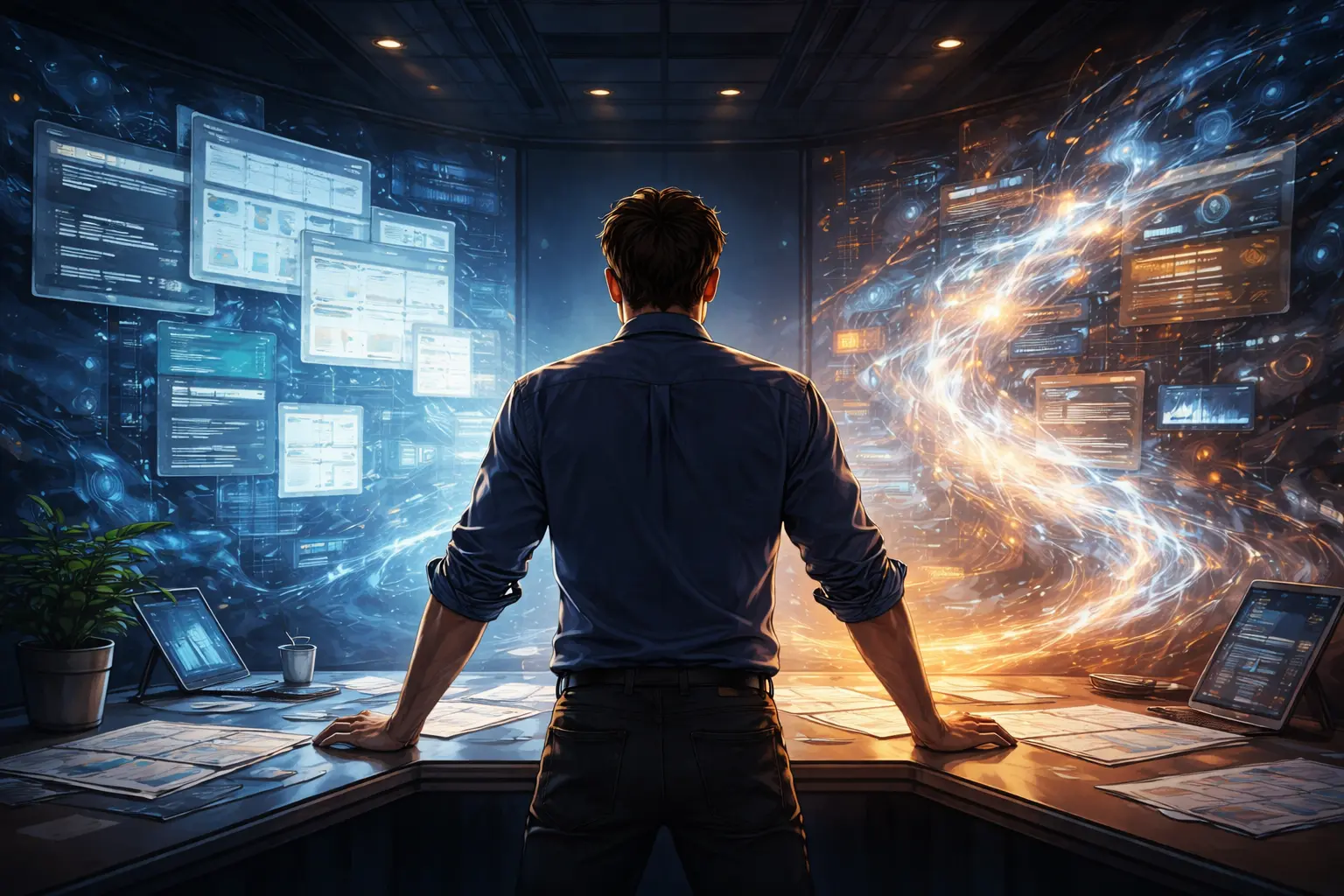
Will emerging AI displace creative jobs - or are fears driven by rumours and incomplete info? We unpack it in our latest article.

AI and culture
The Automation of Human Creativity
Netflix’s embrace of generative AI symbolises a profound shift towards machine-generated art and culture. What are the implications for human creativity?
Written by James Richards
On an otherwise ordinary September morning, a short job post on Netflix’s careers page triggered a small cultural tremor. Buried among listings for content schedulers and localisation managers was a new role titled ‘AI Product Manager’. The description was brief but revealing: the successful candidate would work on generative models to “create compelling narratives” and help shape the future of “storytelling automation”.
The reaction was swift. After a summer of Hollywood strikes partly sparked by fears of AI-generated scripts and digital clones, Netflix’s announcement landed like a provocation. It suggested that the company was not merely experimenting with AI at the margins of production, but actively moving creative work into the domain of computation. The streaming giant that once disrupted distribution now seemed poised to disrupt the storyteller itself.
The Infinite Writer’s Room
Yet this development is less of a rupture than it appears. For a decade, Netflix has treated creativity as a system. The company famously tests hundreds of thumbnail variants, tracking which face, colour and angle will coax viewers into pressing play. It monitors audience reactions to specific scenes, trims runtimes based on attention curves, and commissions series using predictive analytics designed to maximise retention.
Todd Yellin, the Netflix vice president of product innovation who built the platform’s programme recommendation engine, told The Guardian in 2011: “We own the Netflix customer experience from the moment they sign up, for the whole time they are with us, across TV, phone and laptop… We climb under the hood and get all greasy with algorithms, numbers and vast amounts of data.”
Netflix’s adoption of generative AI is therefore not a revolution. It is the natural culmination of a long-standing philosophy: creativity as an industrial process rather than a romantic pursuit. The old myth of the solitary auteur has little place in a world where storytelling is shaped by engagement metrics, behavioural psychology and machine-optimised distribution. Netflix’s embrace of AI does not signal an end to this system; it formalises it.
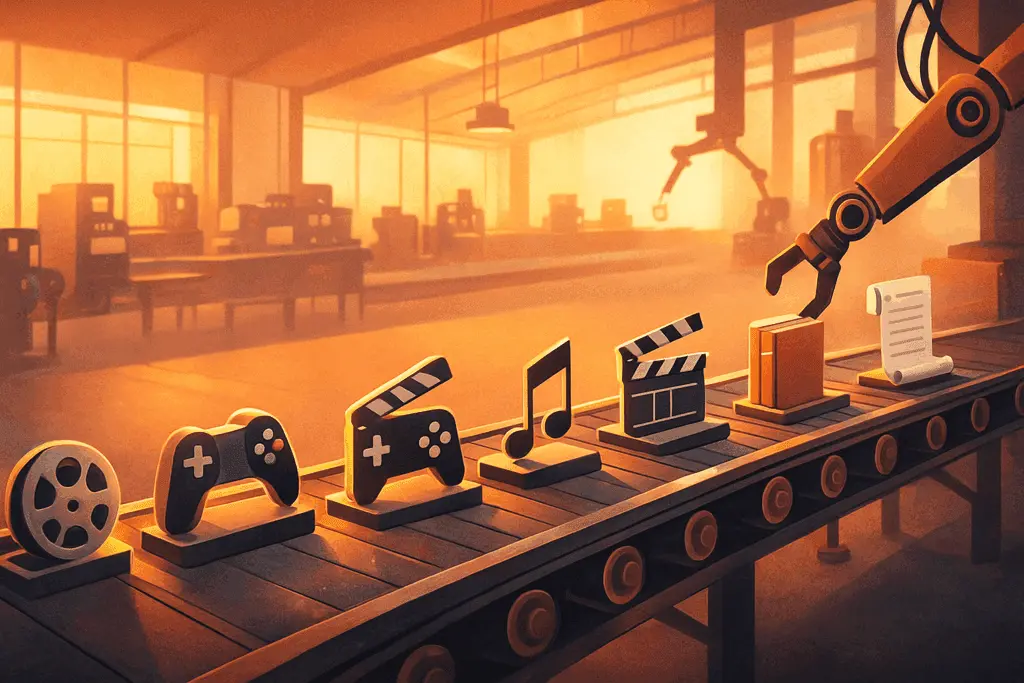
And what is unfolding in film is mirrored across the broader cultural landscape. In music, game design and publishing, creative work is increasingly managed like a supply chain. Efficiency, predictability and scale are the currencies that matter. Creativity is still admired, but it no longer stands apart from the machinery of production. It has become something closer to an operational workflow.
In this sense, the anxiety surrounding AI does not arise solely because machines can write. It arises because it brings to the surface an uncomfortable truth: creative industries have already become mechanised. AI is not the first machine in the room - it is merely the most visible one.
Frictionless Creativity
Over the past eighteen months, the speed of content production has changed with a kind of quiet violence. Tools such as ChatGPT, Midjourney and Suno can now generate competent essays, illustrations and songs in seconds. A screenplay outline that once required a week of structural reimagining can appear in under a minute. A music track can be produced, remixed and mastered before the kettle finishes boiling.
This acceleration forces a basic question: when creation becomes frictionless, does it still hold meaning? Historically, it was the slow, uncertain journey of making that gave art its texture. Drafts were scrapped, brushstrokes corrected, melodies rewritten. The work carried traces of the artist’s struggle, their uncertainty, their discovery. These were not inefficiencies but the very substance of creativity.
Yet there is an important counterpoint that complicates this nostalgia. Creativity has never been entirely unstructured. Writers follow narrative arcs, composers rely on complementary chord progressions, painters learn techniques that guide their hand. Much of what we celebrate as inspiration emerges from constraints, habits and learned forms. AI does not use these structures in the way humans do, but it does detect and mimic the statistical patterns beneath them. That is part of what unsettles people: the machine can reproduce the shape of creativity without sharing any of the experience that gives those patterns meaning.
And yet, a piece of music does not ask whether its composer understands grief before it reaches our ears; a story does not disclose whether the hand behind it has felt love or loss. In fact, the results of AI-generated creativity can still be emotionally and intellectually affecting.
This begs a provocative question: if AI-guided art can move us emotionally, especially when curated or directed by a human, is anything meaningful lost? If a synthetic melody brings comfort, if an AI-written scene prompts a tear, if a digital painting evokes the warmth of a childhood memory, does its origin matter? Is good art defined by the emotions it evokes, or by the labour that produced it?
This conflict sits at the heart of the current cultural moment. Efficiency has expanded what is possible. Friction has historically defined what felt meaningful. We now inhabit a space where both truths collide.
The results of AI-generated creativity can still be emotionally and intellectually affecting.
Can We Tell and Do We Care?
Across the cultural industries, a striking pattern has emerged: audiences often struggle to distinguish human-made work from AI-generated pieces. Blind tests of pop songs created by generative models show that many listeners cannot reliably tell the difference. Short stories produced by large language models pass as plausible literature. Images created by diffusion models have won photography competitions before judges realised what they were looking at.
This raises another question: if the output is convincing, do we care who made it? For many consumers the answer appears to be no. Convenience, novelty and volume often matter more than provenance. Most viewers do not consult the writer’s name before streaming a series. Most music fans do not check who mixed a track before adding it to a playlist. In economies of abundance, attention is directed more toward the end product than its origin.
There is, however, an irony that should not be overlooked. Hollywood has spent decades refining formulas for commercial storytelling. Three-act structures, inciting incidents and redemption arcs became as predictable as the arrival of a Marvel mid-credits scene. In music, the rise of streaming encouraged producers to frontload tracks with hooks to minimise early skip rates. Radio hits converged on similar tempos, chord progressions and vocal effects.
AI did not originate this homogenisation, but it is perfecting it. Its ability to reproduce the shape of modern pop music arguably reveals both the sophistication of the model and the homogenisation of its source material; when the machine mimics us so well, it becomes a mirror that reflects the limits of our own imagination.
And that homogenisation is not an accident: it is the product of a system already optimised for scale and repetition. Despite the hype surrounding AI as a disruptive force, the creative industries have been evolving toward automation for years. Platform economics reward scale, speed and consistency. Creative workers have long been pressured to produce more in less time, to conform to established formulas, to optimise their work for algorithms rather than audiences.
Netflix’s model exemplifies this shift. By reducing creative decisions to data-driven predictions, the company has turned storytelling into a system governed by engagement metrics. AI simply accelerates and deepens this logic. The winners in this landscape are not necessarily the most imaginative artists but the platform owners who control distribution and data.
does it really matter?
Reducing barriers to entry
Yet the story is not entirely one of loss. New technology also lowers barriers to entry. Independent creators can now produce work that would once require large studios. A songwriter can release an album without a label. A hobbyist filmmaker can generate visual effects that rival those of major franchises. Tools that once demanded years of training or significant budgets are now available at minimal cost.
This democratisation opens new possibilities. Small studios may find themselves competing with global players. New voices may emerge outside traditional gatekeeping structures. Some creators will reinvent their practice around these tools and discover forms of expression previously unimaginable.
But new possibilities bring new tensions. As output becomes more abundant and increasingly indistinguishable, creative work risks becoming disentangled from meaning. Value may shift away from the work itself toward the audience’s scarce attention. In such an environment, algorithms determine what is seen, and creators risk becoming subcontractors to the machine.
And although these dynamics have been building for years, the advent of generative AI pushes the logic to its limit. When creation becomes abundant and frictionless, it forces a more fundamental cultural question: if stories, songs and images become pure content, what becomes of the meaning we once attached to human art and craft?
The Human Touch and the Loss of Craft
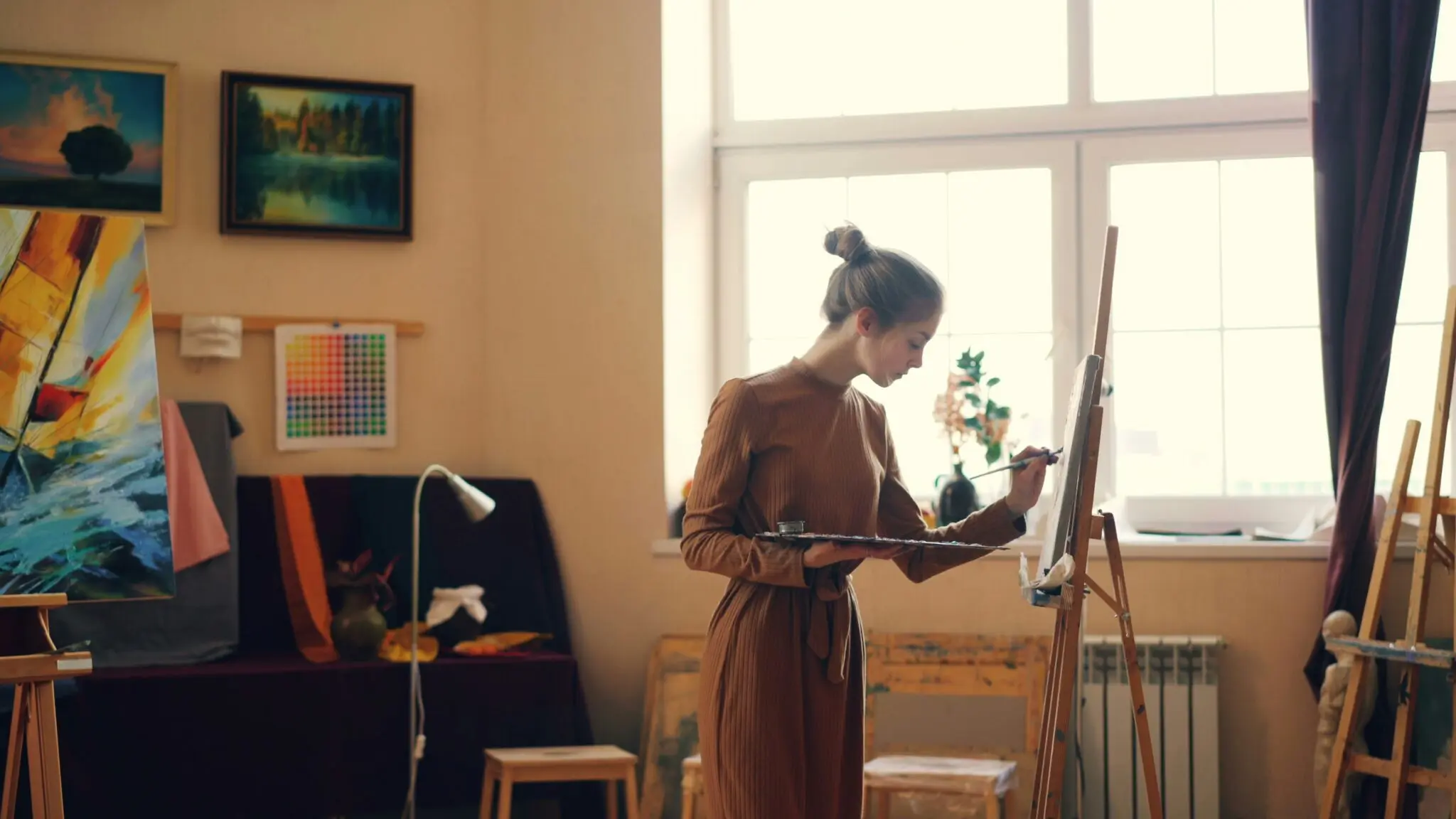
For generations, artists have argued that true quality depends on human intuition and taste. Craft is not merely technical skill but a cultivated sensitivity to the emotional, social and cultural contexts in which work is made. The concern today is not simply that AI might replace this intuition, but that its growing presence could erode the conditions under which such intuition is formed.
If creative tools increasingly automate the steps once learned through practice, new generations may lose not creativity itself but the feel for it. A painter develops an eye for light only by observing it, mixing it and wrestling with how it behaves on a surface. A writer grasps the rhythm of a scene by failing at it, revising it and learning what emotional beats matter. When software performs these tasks automatically, the experiential groundwork that produces expertise is quietly removed.
And as that foundation thins out, something shifts not only in the making of art but in how we receive it. Audiences learn to recognise depth, subtlety and intention because generations of makers have embedded those qualities in their work. If the craft becomes more mechanical, our collective sensitivity may narrow alongside it, leaving us less equipped to distinguish between surface polish and genuine insight.
This leads to a deeper philosophical concern. AI can reproduce the outward shape of emotional or aesthetic choices, but it cannot supply the lived experience that once anchored those choices. Meaning in art has always been a dialogue between maker and audience – a meeting of intention on one side and interpretation on the other. If the maker’s intention is increasingly procedural, and the audience’s interpretation becomes accustomed to that procedural surface, the shared framework that once gave art its depth begins to thin. Good and bad risk becoming questions of pattern fidelity rather than emotional or cultural resonance.
The danger, then, is not that AI will flood the world with hollow art, but that we may gradually lose our ability to perceive the difference. We may not lose creativity, only the memory of how to recognise it.
Creative Industry Pushback
Faced with that possibility, it is no surprise that resistance is emerging on multiple fronts, from film and TV, to music and publishing. Creative workers, audiences and entire industries are beginning to push back – not necessarily because they reject technology, but perhaps because they recognise what is at stake if human intention becomes invisible within the cultural landscape. This resistance is not Luddite in spirit; rather an attempt to halt progress, it is a demand to shape it.
In film and television, writers’ unions have negotiated guardrails on AI use, ensuring that models should not replace human authorship in scripted content. In response, Netflix has recently published official guidelines for its use of generative AI in content production. Those guidelines require that production partners disclose any use of generative AI, especially when it involves final deliverables, talent likeness, copyrighted material, or creative work that could replace union-covered authorship. They also state that new AI-tools should not be used to replace writers, actors or other union-covered roles and, if used, full disclosure and consent is required.
On paper, Netflix therefore appears to recognise the ethical and labour concerns around AI – and has attempted to reconcile them with its ambitions. Whether these guardrails are realistic or enforceable remains to be seen, but evidently, creative industry pushback is proving fruitful in some areas.
On paper, Netflix therefore appears to recognise the ethical and labour concerns around AI.
Elsewhere, A-list actors such as Robert Downey Jr and Keanu Reeves have refused offers to license digital replicas of their likeness, arguing that control over their own identity is non-negotiable. The concern is not merely economic, in terms of protecting intellectual and creative property, but also existential, in the sense that creative work is tied to personal worth and cultural contribution.
In the music industry, artists have protested the unauthorised cloning of their voices and demanded consent laws for synthetic reproduction. Major labels and streaming platforms have begun watermarking AI-generated tracks, signalling both a practical and symbolic desire for transparency. Even as tools for synthetic vocals improve, the industry is grappling with what it means for a voice to belong to someone.
In literature, authors have sued model-makers for scraping their work without consent. Publishers are experimenting with AI-assisted tools, but many emphasise the irreplaceable value of human credit and accountability. The small details of style, rhythm and tone that define a writer’s voice cannot be reduced to pattern replication without losing something essential.
Throughout these debates, a consistent theme emerges. Creative workers are not opposed to technology. They are opposed to invisibility . They want to remain authors rather than free sources of training data. They want their labour, vision and identity to be acknowledged rather than absorbed into vast computational systems. After all, AI models exist only because of the corpus of books, performances and music created by human beings in the first place.
What many fear is a quiet transfer of value: years of human craft and effort becoming raw material for systems whose benefits flow primarily to the companies that own them. The fight is not against machines themselves, but against the unfairness and exploitation that can accompany their use.
This push-back from makers mirrors a quieter, more organic response unfolding among audiences. Even as artists fight for authorship and agency, consumers are beginning to seek out forms of creativity that machines cannot easily imitate.
Film & TV
AI Developments
AI-assisted scripting; Netflix AI guidelines.
Pushback
Union guardrails; disclosure and consent rules.
Core Concern
Preserving authorship and protected roles.
Actors
AI Developments
Digital doubles; synthetic likeness offers.
Pushback
A-list refusals; insistence on identity control.
Core Concern
Personal autonomy and non-exploitation.
Music
AI Developments
Voice cloning; watermarking of AI tracks.
Pushback
Demands for consent laws and voice rights.
Core Concern
Ownership of voice; authenticity.
Publishing
AI Developments
AI-assisted tools; scraping of books.
Pushback
Lawsuits; emphasis on credit and accountability.
Core Concern
Protection of voice, style and compensation.
Audiences
AI Developments
Rising presence of AI-generated media.
Pushback
Growing preference for human-made work.
Core Concern
Authenticity and cultural meaning.
The two-tier cultural economy
As a result, a split-level cultural economy is starting to take shape. On one side sits a vast landscape of mass entertainment produced or heavily assisted by AI: the endless stream of synthetic images, rapid-fire songs and algorithmically tailored stories designed for frictionless consumption. On the other side is a smaller but increasingly valued category of explicitly human-made work, distinguished not by scale but by scarcity, intention and craft.
The appeal of this second category is not simply nostalgia. Audiences have a remarkable ability to detect the fine-grained cues that reveal authenticity: an accent slightly off, a phrase used out of context, an emotional beat that lands just outside the expected rhythm. These subtle misalignments matter because human culture is built on nuance, not only on form. AI may imitate patterns with precision, but it does not inhabit culture from the inside.
This distinction becomes even clearer when we consider the difference between biological and machine intelligences. Humans are shaped by sensation, memory and the physiological substrate of experience. Our reactions to beauty, tragedy or humour are inseparable from the bodies in which they occur. Machines, by contrast, operate without phenomenal consciousness. They can rationalise why a chord progression is pleasing, but they cannot be pleased; they can articulate why an act is immoral, but they cannot feel moral outrage. Their capabilities may be extraordinary, but they lack the subjective anchor that gives human expression its depth.
In a world where everything can be generated instantly, slowness becomes a statement.
The Return of Handmade
For some artists and audiences, this differentiation becomes a source of value. A handmade object, a live performance or an imperfect line drawn by a human hand gains meaning precisely because it carries the traces of the person who made it. Human art is not inherently superior, but it embodies a qualitative dimension absent from synthetic work: a sense of intention shaped by lived experience.
As this sensibility grows, small but passionate audiences are gravitating toward forms that cannot be easily replicated by machines. Live theatre is experiencing a resurgence despite financial pressures. Handmade pottery, analogue photography and physical printmaking have become markers of authenticity. Even the imperfections of a shaky camera or uneven brushwork have taken on new aesthetic value.
This shift is not merely reactive. It reflects a deeper desire for presence and experience. In a world where everything can be generated instantly, slowness becomes a statement. The time it takes to learn an instrument, to mix paint, to carve a piece of wood becomes a form of resistance against the logic of efficiency. Authenticity, once a nebulous concept, becomes a differentiator with tangible value. Consumers develop an appetite for work that carries the fingerprints of its maker, and artists rediscover the pleasure of the physical act of creation precisely because it cannot be outsourced.
In this emerging landscape, the human journey itself becomes part of the value proposition. The story behind the work matters because it is something a machine cannot supply.

creativity is largely automated.
The New Meaning of Creativity
In the end, the questions raised by AI are not simply technological but existential. Creativity has always mattered because it testifies to care, risk and intent. It reflects the journey of a mind encountering the world, interpreting it and expressing something that cannot be expressed in any other way. Machines can simulate this, but they cannot inhabit it.
We can see this distinction in other domains too. Would we cheer robot athletes performing feats of impossible endurance or shattering world records? Perhaps, but not for very long. We marvel at artists and actors because they achieve something remarkable despite being human - fallible, limited and very much like us.
While AI can match our products but not our purpose, then in some senses what is being automated is not creativity itself but the mechanisms around it. Although the models may be able to generate convincing images, melodies or sentences, they do not originate the curiosity, intention or desire that gives those things meaning. The act of making still belongs to humans. It is humans who choose what to pursue, why it matters and how it fits into a larger story. The desire to understand, to feel, to interpret, to imagine remains ours. These impulses come from lived experience and consciousness – qualities a system can mimic in output but cannot possess.
This shift demands a deeper reflection on what creativity is in an age of automation. Perhaps humans will increasingly act as directors, setting visions and defining strategies while machines execute the details. Perhaps new forms of hybrid creativity will emerge, merging human intuition with computational power. Or perhaps there is a risk that too much delegation turns art into a form of karaoke, where stories exist without stories behind them.
The question is not whether AI can create high quality art. It already can. The real question is whether art created without human experience can ever hold the same meaning. Stories derive their power not only from narrative structure but from the consciousness that produces them. Without that interior life beneath them, the shape of the story remains, but the pulse inside it fades.
While the algorithm can certainly tell a story, only humans can believe one.


Built by No Latency
Play Paradigm
A scenario game where you become a software company owner and navigate the choices around adopting AI.
Play the game