Decoding the digital age
1,254 posts. 2,088 comments. 13 years

Internet
1,254 posts. 2,088 comments. 13 years.
How AI helped me take ownership of my digital footprint, and what this says about our ideas of digital ownership.
Guest article by Samuel John
Macs are for lightweights
“Macs are for people who don’t know how to use computers”, Patrick M, 2004
I still remember this barb from a friend, an avid gamer and Apple-hater. Granted, he said this during our junior year of college, when iPods and white laptops were just becoming a noticeable addition to the regular back-to-school fare. I had both: a fourth-generation iPod and a G4 iBook.
His insult struck me as odd: Macs were, after all, computers… that people used.
But underneath this illogic was another assumption: that using a computer demanded a certain level of technical savvy. In this view, dragging and dropping without knowing what was under the hood was somehow amateur, infantile.
Like never learning how to drive stick.
Early LiveJournal Adopter
Around the same time, I was an avid LiveJournal user.
I had been gifted an invitation link in May 2003 and was regularly writing up to five entries a day. Sometimes these were just quizzes (“Which Love Hina character are you?”) or psychologically probing surveys (What’s Your Favorite Color? Blue. Favorite Coke Flavor? Vanilla. Celebrity Crush? Uma Thurman).
Other times I would write long emotional reflections or wannabe op-eds for The New York Times. My high school and undergrad friends left comments, 2088 of them, and started their own journals, tagging me in the process. Some LiveJournal friends transcended the medium and became a part of my social life. Others stayed digital. It’s fair to say that LiveJournal was a huge part of my life in the early 2000s, and I wrote in mine until 2016.
A Madman’s Journal
Over the years, my LiveJournal accumulated stories from my university years, my internship on a presidential campaign, my semester abroad in St. Petersburg, Russia, my thoughts about the Iraq War. LiveJournal was with me during my journey to California for graduate school along with many abortive romances. It was with me for five years in Houston, Texas, and accompanied me back to Russia. By the end of my time on the platform, I was writing with more literary flourish. My entries read more like prompts for art therapy: less political, more interior. I titled my LiveJournal “Diary of a Madman”, an allusion to a Nikolai Gogol story.
When, after over a decade of use, LiveJournal began to feel like yesterday’s news, I continued writing on a different platform, Tumblr, for three years: “Different Diary, Same Madman”. My third blog was on WordPress, the online version of my work in a writing club that kept me sane during the early days of the pandemic.
Moving to Medium
It’s said that a poem is never finished, only abandoned. The same could be said about my blogs. Over the years, the impetus to continue chronicling my inner thoughts dwindled. And yet I felt the pull of wanting to be a “serious” writer, and started using Medium around 2020, even paying for a membership. The site had a clean, minimalist aesthetic that I enjoyed.
But in August 2026, an event took place that made me reconsider the entire nature of my online writing oeuvre.
I discovered that a post I’d written on Medium had been flagged, and my account suspended. I panicked: I’d put real effort into this platform, and it was my most public-facing presence online.
After two messages to Medium’s tech support, I was relieved to be told that my post was flagged by mistake and my suspension was lifted. The algorithm had spoken out of turn, and now all was well.
Decision to Take Ownership
But what if it hadn’t been? What if one of these platforms decided, with or without good cause, to remove my work from the internet? That wasn’t something I was comfortable with.
I came to two conclusions: 1) the writing I’d amassed over the previous decade wasn’t necessarily safe, and 2) I would need to consider an alternative platform.
But the big problem was in figuring out how I’d take ownership of thousands of posts scattered across three different platforms, when my technical skills were seriously limited, not even a hobbyist, no less a hacker (Apple devices everywhere, but not one line of code).
Perhaps artificial intelligence, much-hyped, much-feared, could offer a solution?
Early Use of AI
My first foray into ChatGPT was in 2025. Initially, I used it for advice on how to start composting in my apartment, but I also used it to talk out emotions and feelings. I treated it as a tool, not as a friend. I was closer to my iPad, Cate Planshett (which is the Russian word for “tablet”). My GPT agent never even got a name.
I found it useful for my job as an English teacher, helping to calibrate my assessments of students’ work, and as a spellchecker and copyeditor for assignments I’d written. But I was well aware of the negative aspects of this technology – the dangers of sliding into a culture where ‘creative’ work is simply probabilistic assemblage on the part of word-prediction machines.
But there was something that I was happy to let it generate for me.
Not a headline.
Not a thesis.
Not a better paragraph.
But maybe a website?
Calling the AI Cavalry
I asked ChatGPT what could be done about my extensive but precarious writing archive. It walked me through downloading the XML/HTML files for WordPress and Tumblr, a painless process that didn’t take even an hour to complete. Once I had the files, I deleted the blogs.
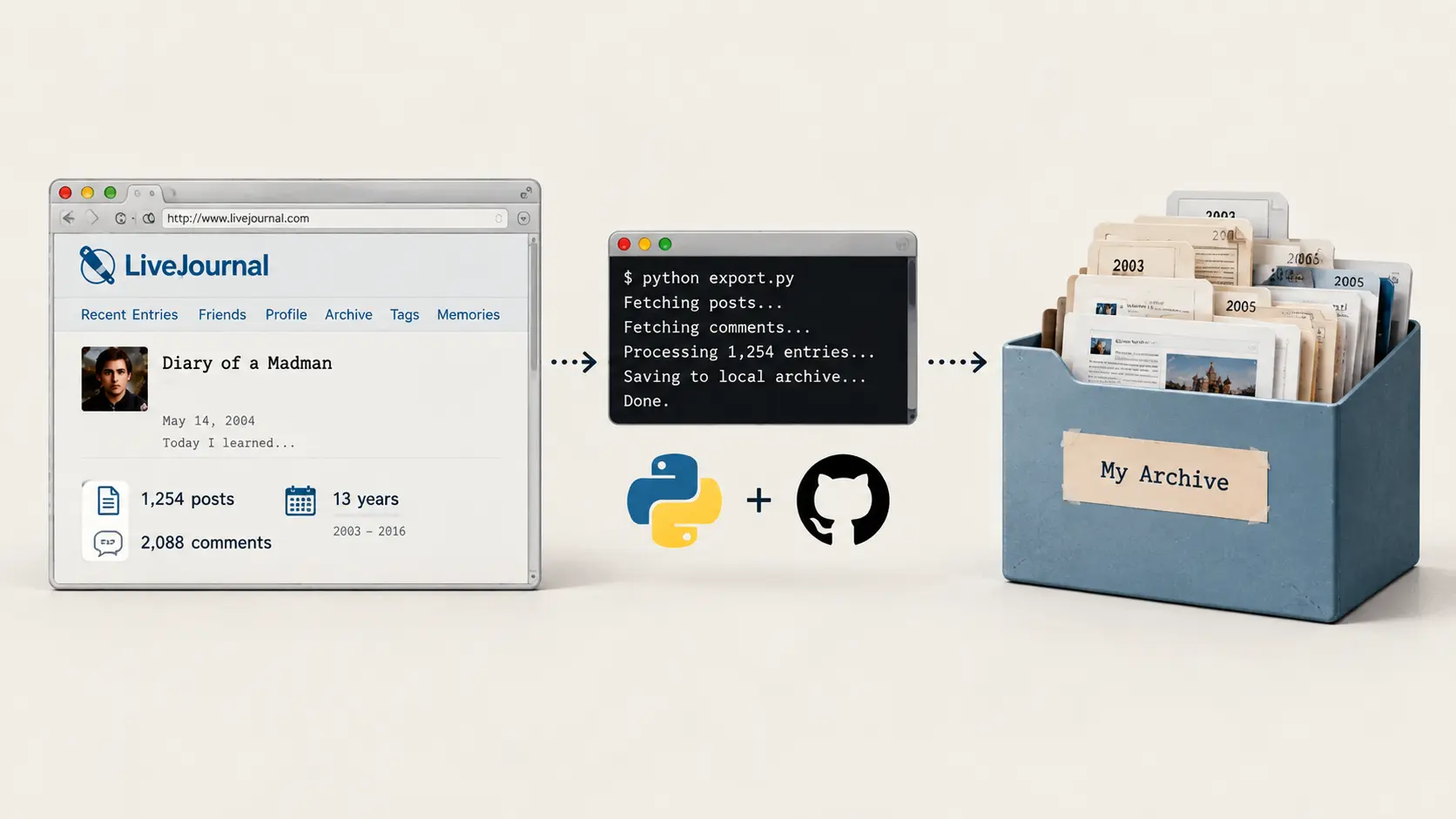
My LiveJournal, however, presented a different challenge. I had over 13 years’ worth of material there. LiveJournal’s official export facility only exports one month at a time and does not include comments. Over a decade ago, there were programs for downloading your journal into a tidy PDF, but these have since disappeared.
I calculated that painstakingly copying and pasting each entry into a text document would take about four months if I did ten a day. Not an insurmountable task, but surely I had better things to do with my time. Here I asked ChatGPT what it could suggest. This was the workflow:
- Download Python
- Download an export tool from GitHub
- Save the LiveJournal locally
- Delete it online
ChatGPT walked me through each step and spent a good hour or two troubleshooting with me. In one evening, I was able to download my entire journal. Just to be sure, I searched for a few memorable entries and found them: the soda machine spraying a hapless sophomore, the chatty Roy Rogers employee in Breezewood, PA.
They were totally intact.
With comments.
All 2088 of them.
Mission accomplished.
The Rise and Russification of LiveJournal
While waiting for the entries to download, I asked ChatGPT to detail, in brief, the rise and fall of LiveJournal. It turns out that the platform began in a very Zuckerbergian way: a young guy created it to keep in touch with his friends and family. It got big, got bought, then sat uneasily in a corporate family. Later, it was acquired by SUP Media, a Russian company, in 2007, and moved its servers to Russia in 2016. Coincidentally, this was right around the time I moved back to St. Petersburg.
LiveJournal and I had both, somehow, ended up in Russia in the mid-2010s. I knew that it was popular there, but I had no idea that it had physically and legally migrated. Had LiveJournal’s algorithm wanted, it could have pushed my stories about being hospitalized for pneumonia or feeling queasily lovesick on Rubenshteina Street directly to my new neighbours.
LiveJournal remains a popular platform in Russia, known as “ЖЖ,” “ZhivoyZhurnal”, and operates in 33 languages with almost 40 million accounts. I left Russia in 2026, but LiveJournal remains.
Making it Mine
After securing my posts, I asked the AI another question: can I rename these files with their actual post titles? It replied in the affirmative, and it took just two runs of trying out the script it created to restore my numbered files to their original names.
All in all, to transform over 13 years’ worth of writing into something secure, searchable, and fully under my control took about four hours. LiveJournal could shut down tomorrow, move its servers to North Korea, or decide to do any other such thing – and my content will remain unaffected. What I want to share, I can share. What I want to hide, I can hide. No platform has sole authority over my writing now.
The Power of AI: Tools for the Tech Novice
I could not have accomplished this task without help. Now, I skipped every opportunity to learn computer science or basic programming in school and college. I needed a computer for writing, chatting, and watching Star Wars parody videos. Today, my actual workload is a little more demanding, but it is even more accessible because of OpenAI (or Anthropic if you prefer).
And yes, I’m still using a Mac. I’ve come to realise that generative AI represents a similar evolution of easy-to-use technology that democratises complex digital processes. In my case, I had a vision of what I wanted: a complete, searchable copy of my LiveJournal. I didn’t have the technical know-how of how to make this happen, but generative AI found the tools, troubleshot the code it generated, and allowed me to complete the task I wanted to complete. I didn’t need to hire someone or learn a programming language to accomplish these few discrete operations.
Taking Back Control
Now I keep my writing and video work where I’m in charge. My writing lives on Neocities, a platform that hosts whatever pages its users create. It’s also home to a $5 donation I made to show my appreciation. Neocities comes with HTML tutorials, and using it is a decidedly Web 1.0 kind of experience. I am free to take all of the markdown files with me if I decide to host my work elsewhere. Similarly, my video content is on PeerTube, which is a decentralized, federated network. Unlike their counterparts, Medium and YouTube, these sites are distribution channels, not guardians of my intellectual property.
Admittedly, these platforms could still go offline or change their terms of service, or be acquired by a rogue billionaire. But even if they do, I still have my own copies of my writing and the freedom to publish it elsewhere.
After over 20 years online, with the aid of AI, I don’t feel strapped into a booster chair, dazzled by impenetrable, glossy electronics, just along for the ride.
I finally feel like I’m in the driver’s seat.