Decoding the digital age
Human Thinking in the AI Era
Artificial intelligence and human thought are fundamentally different. Yet as AI systems spread, we are increasingly nudged to think and act according to the logic of machines.

AI & cognition
Human Thinking in the AI Era
Artificial intelligence and human thought are fundamentally different. Yet as AI systems spread, we are increasingly nudged to think and act according to the logic of machines.
In offices, meetings and living rooms, a new kind of language is emerging:
I asked the AI what it thinks.
The model thinks this approach is best.
This kind of language slips out naturally. Yet it hides an important difference. Humans think. Machines process information.
The seemingly obvious distinction is easy to forget once AI systems start producing fluent language, structured arguments and plausible explanations at the touch of button. It’s natural that we regard the process as a kind of accelerated thinking.
But machine processing and human cognition operate in fundamentally different ways. And with AI now appearing in almost every corner of modern life, that difference has real consequences for how we work, learn and make decisions.
What is ‘AI thinking’?
Advanced AI models that use natural language processing and deep learning, such as ChatGPT and Claude, are really prediction machines. Given a prompt, they predict the most probable continuation of a sequence of words by performing continuous statistical computation across vast networks of parameters.
The actual sequence goes something like this:
- A user types a prompt into an interface like a browser or coding environment
- The text is converted into numerical units known as tokens
- These tokens are then passed through a trained neural network - often containing tens or even hundreds of billions of parameters - which calculates the statistical likelihood of the next token in the sequence
- That token is selected, appended to the output, and the process repeats
- Word by word, sentence by sentence, the response emerges.
Under the hood, the calculations are performed on specialised hardware in large data centres, typically using clusters of GPUs or other AI accelerators designed to carry out vast numbers of mathematical operations simultaneously. The architecture is massively parallel: thousands of processing cores working together to perform the matrix multiplications that underpin modern neural networks. Each request briefly draws on a small slice of this infrastructure, generating a response in a fraction of a second before the system moves on to the next task.
The fluent language produced by modern AI models can make the process feel far more like thinking than it really is
A Machine that Seems Human
The process is extraordinarily powerful and increasingly useful. But it remains fundamentally mechanical. The system does not perceive, pause, reflect or reconsider. Once given a task, it simply completes the computation and then stops.
From the user’s perspective, the experience feels conversational. A question is asked and an answer appears. But what is actually happening is a sequence of statistical predictions unfolding at high speed across a distributed computing system.
Crucially, none of this computation occurs until a prompt arrives. Unlike a human mind, which continues thinking, perceiving and integrating information even when no specific task has been assigned, an AI model remains inert until it is asked to generate a response. Once the prompt is received, the model performs the required calculations, produces an output, and then stops.
In that sense, artificial intelligence systems do not possess a continuous inner life. They do not reflect between questions or reconsider earlier answers. Each response is a fresh computation triggered by a new input. Understanding this distinction is important, because the fluent language produced by modern systems can make the process feel far more like thinking than it really is.
What is ‘Human Thinking’?
Human thinking works very differently.
At its most basic level, human thought is associative rather than purely sequential. Ideas do not emerge one token at a time through explicit calculation, but through networks of memory, perception and emotion that are constantly interacting. A single stimulus can trigger a cascade of related concepts - images, past experiences, feelings and intentions - many of which never fully enter conscious awareness. This process is shaped by biological drives and goals, from curiosity and problem-solving to social understanding and survival. Thinking, in this sense, is not just the manipulation of symbols. It is an embodied activity, grounded in a living system that is continuously interpreting the world and acting within it.
Unlike artificial systems, the human mind does not operate as a continuous stream of explicit calculation. Our cognition moves through cycles: periods of focused attention alternating with moments of reflection, perception and integration. Anyone who has wrestled with a difficult problem will recognise the pattern. Concentrated effort may produce incremental progress, but genuine insight often arrives later, during a walk, in the shower, or while doing something entirely unrelated.
Human Thinking vs AI Processing
Human cognition and machine computation operate according to very different rhythms, strengths and constraints.
| Dimension | Human Thinking | AI Processing |
|---|---|---|
| Activity Pattern | Continuous mental activity shaped by perception, memory and experience. | Inactive until prompted; computation begins only when a request is received. |
| Temporal Structure | Cycles of focus, reflection and integration. | Rapid statistical calculation in a single continuous process. |
| Emergence of Insight | Insights develop gradually, often after pauses or distraction. | Outputs are produced immediately once computation begins. |
| Mode of Judgment | Integrates emotional, social and ethical reasoning. | Optimises for statistical likelihood within training data. |
| Source of Knowledge | Lived experience, intuition and contextual understanding. | Patterns learned from large datasets. |
| Core Strengths | Interpretation, creativity and reframing problems. | Pattern recognition, prediction and rapid structured generation. |
Much of the brain’s activity takes place outside conscious awareness. Neuroscientists estimate that the majority of mental processing occurs below the level of deliberate thought, quietly integrating memories, sensory information and emotional cues. The result is that what we experience as a sudden idea or intuition is often the visible outcome of a much longer internal process.
Human thinking is therefore not simply about producing answers on demand. It depends on pauses, shifts of attention and the gradual accumulation of experience. Reflection matters. So does perception. A scientist observing an experiment, an artist studying light and colour, or a writer searching for the right phrase are all engaged in forms of cognition that extend beyond pure symbolic reasoning.
Anyone who regularly works with AI systems will recognise the experience: a question is asked, and seconds later a dense wall of text appears.
In other words, thinking is not just computation. It is an activity that unfolds across time, shaped by perception, memory and experience.
And crucially, it rarely happens in isolation.
Even the most solitary intellectual work is supported by tools, environments and external structures: notebooks, diagrams, books, libraries, software and conversations with other people. These artefacts do not merely store ideas. They help organise them.
To understand how modern AI systems affect human thinking, we therefore need to look beyond the brain or the machine alone. What matters just as much is the environment in which thinking takes place.
Understanding Cognitive Ecology
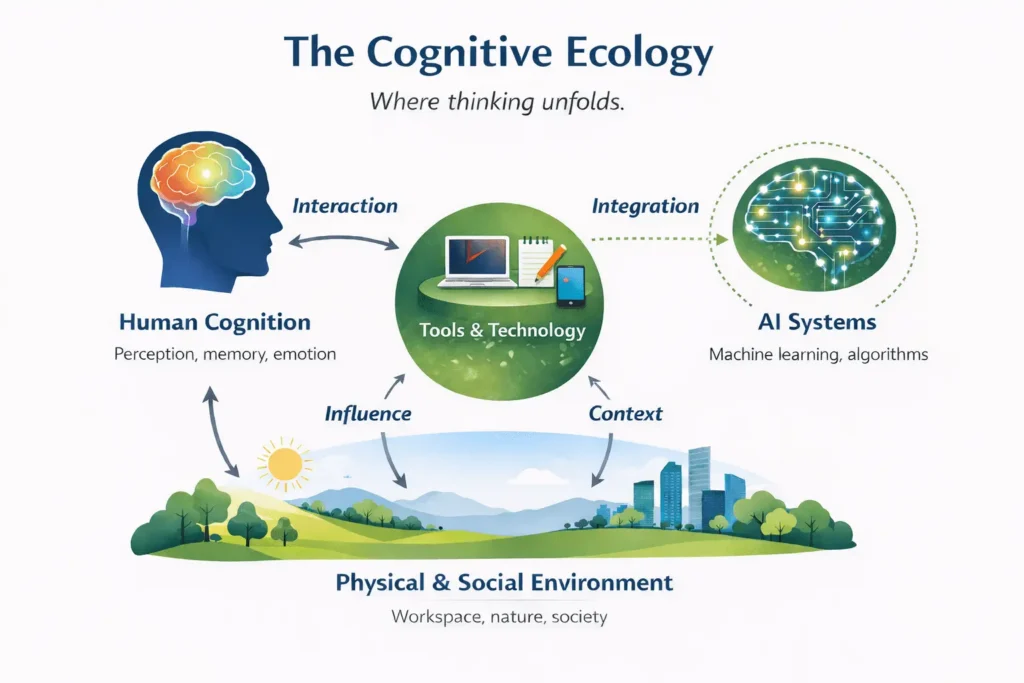
In the real world, human cognition unfolds within a landscape of tools, artefacts and information systems that shape how ideas are formed, organised and refined. Philosophers and cognitive scientists (particularly Edwin Hutchins, who developed the concept) refer to this broader environment as a cognitive ecology the network of technologies and practices that structure how thinking happens.
History offers many examples of these environments transforming intellectual life. The development of written language, for instance, allowed ideas to be recorded and revisited across generations. The printing press dramatically expanded access to knowledge and accelerated the spread of scientific and political thought. In the modern era, libraries, databases and search engines have reshaped how information is stored and retrieved.
In each case, the tools did more than simply store knowledge. They changed the way people reasoned.
A mathematician thinks through symbols and notation. An architect thinks through sketches and diagrams. A researcher thinks through archives, references and datasets. The tools are not merely accessories to thought; they are part of the thinking process itself.
The Nature of Distributed Cognition
This insight lies at the heart of a closely related concept known as distributed cognition. Rather than viewing intelligence as something confined within an individual brain, distributed cognition treats thinking as an activity that emerges from interactions between people, tools and environments.
Consider a pilot navigating a complex aircraft. The task is not performed by the pilot’s brain alone. It is distributed across cockpit instruments, navigational systems, written procedures and communication with other crew members. The thinking system includes both the human operator and the technological environment surrounding them.
From this perspective, modern artificial intelligence is not simply another digital tool. It represents a new layer in the cognitive ecology of modern work.
AI and Distributed Cognition
Unlike earlier thinking technologies, which primarily stored or organised information, AI systems can generate new material on demand. They can summarise research, draft arguments, propose ideas and restructure complex information within seconds. Increasingly, they participate directly in the process of reasoning itself.
In effect, AI is becoming a new component of the distributed thinking systems that underpin modern knowledge work.
In many workplaces this shift is already visible. Software developers now use AI systems to generate draft code, suggest fixes and explore alternative approaches to complex problems. Researchers use generative models to summarise papers and identify connections across large bodies of literature. Marketing teams brainstorm campaign ideas with conversational AI tools before refining them into finished material. In each case the system is not replacing the human thinker, but participating in the process itself - proposing possibilities, restructuring information and accelerating the early stages of reasoning. The thinking task becomes distributed across the person, the software interface and the underlying computational infrastructure.
Yet this new kind of cognitive partnership differs in one important respect from the tools that preceded it.
AI and the Tempo of Thought
For most of human history, the tools that supported thinking were relatively slow. Books had to be read, archives searched, calculations performed by hand. Even with the arrival of digital technologies, many intellectual tasks still required deliberate effort: scanning documents, assembling notes, testing ideas through drafts and revisions.
These forms of friction imposed natural pauses in the thinking process. They created small intervals in which ideas could settle, connections could emerge and assumptions could be reconsidered. Much of the value of traditional research and creative work lies precisely in these slower rhythms of attention.
Artificial intelligence changes that tempo.
Where earlier tools primarily stored or retrieved information, generative AI systems actively produce it. A user can pose a complex question and receive a structured response within seconds. Draft reports, summaries and arguments can be generated almost instantly. In many cases, the system produces far more material than a person would normally generate in the same amount of time. The result is a subtle but important shift in how thinking unfolds.
Abundance and the Saturation Problem
Instead of gradually assembling ideas through a series of steps, users are increasingly presented with large, pre-structured blocks of information. A single prompt may produce pages of analysis, suggestions or explanations. While this can be enormously useful, it also changes the cognitive rhythm of the task. The challenge is no longer simply generating ideas, but processing and evaluating a sudden abundance of them.
Anyone who regularly works with AI systems will recognise the experience: a question is asked, and seconds later a dense wall of text appears. The user must now scan, interpret and judge the response while deciding what to keep, discard or refine. The system accelerates the production of information, but the human mind still has to absorb it.
Anyone who regularly works with AI systems will recognise the experience: a question is asked, and seconds later a dense wall of text appears.
In effect, generative AI compresses parts of the thinking process that were previously spread across time. Steps that once required hours of reading or drafting may now occur within seconds.
For machines, this acceleration is natural. Digital systems are designed for continuous processing. They operate most efficiently when calculations proceed without interruption. Human cognition, however, evolved under very different conditions.
The Human Brain: Shifting States of Thought
Our thinking depends on shifts between different modes of attention: concentrated effort, diffuse reflection, perception and integration. Periods of intense focus are often followed by moments in which the mind wanders, quietly reorganising information in the background. Psychologists sometimes refer to this as the brain’s “default mode” of activity, during which ideas are consolidated and new associations form.
Critically, these cycles are not inefficiencies. They are essential features of human cognition.
Cycles of Human Thought
The human brain operates across a spectrum of electrical states, shifting fluidly between modes of focus, reflection and restoration.
| Brain State | Frequency (Hz) | Associated Mode | Typical Characteristics |
|---|---|---|---|
| Gamma | ~30–100 Hz | Peak cognition | High-level processing, insight, integration of information; moments of intense clarity or flow. |
| Beta | ~13–30 Hz | Active thinking | Focused attention, problem-solving, decision-making; can tip into stress or overanalysis. |
| Alpha | ~8–13 Hz | Relaxed awareness | Calm, reflective state; light creativity, daydreaming, early meditation. |
| Theta | ~4–8 Hz | Deep creativity | Dreamlike thinking, visualisation, memory access; often emerges before sleep or in deep meditation. |
| Delta | ~0.5–4 Hz | Restoration | Deep, dreamless sleep; physical recovery, minimal conscious awareness. |
Creativity, insight and long-term understanding often emerge not from uninterrupted concentration, but from the interplay between focused work and moments of distance from the problem. The sudden solution that appears during a walk or in the middle of the night is rarely accidental. It is usually the visible outcome of a longer, partly unconscious process.
The growing presence of AI within everyday workflows raises an interesting question. If our cognitive environments increasingly encourage rapid interaction and continuous output, what happens to these slower cycles of thinking?
This is not simply a matter of productivity tools becoming more powerful. It is a shift in the conditions under which thought itself takes place.
Dangers of the False Comparison
The risk is not that artificial intelligence will replace human thinking altogether. In many cases, these systems clearly augment it. They can surface relevant information quickly, suggest alternative approaches and help people explore ideas that might otherwise take much longer to develop. The more subtle risk lies elsewhere.
As AI becomes embedded in everyday workflows, it becomes tempting to measure human performance against the logic of the machine. A system that can produce pages of structured output in seconds naturally encourages expectations of continuous productivity. When viewed through that lens, moments of reflection, hesitation or apparent inactivity can begin to look inefficient.
As AI becomes embedded in everyday workflows, it becomes tempting to measure human performance against the logic of the machine.
In reality, these pauses are often where the most important forms of thinking occur.
After all, human cognition excels in ways that differ fundamentally from statistical processing. We are capable of making intuitive leaps between distant ideas, recognising patterns that are only loosely connected, and generating insights that cannot easily be derived from existing data alone. Creative breakthroughs frequently emerge from this capacity to move beyond strictly linear reasoning.
Human thinking is also deeply shaped by perception and experience. Scientists interpret experimental results through years of accumulated knowledge. Designers draw on aesthetic judgement developed over time. Writers sense when an argument feels persuasive or incomplete. These forms of understanding rely not only on information, but on interpretation.
Ethics and Moral Human Mind
There is also the question of judgement. Human decision-making is embedded within social and ethical frameworks. People weigh consequences, consider responsibilities and debate competing values. Moral reasoning is rarely a purely computational exercise; it is informed by empathy, cultural norms and lived experience.
None of these processes operate well under conditions of constant output. They depend on time, distance and the ability to step back from immediate tasks.
When organisations treat human thinking as if it were equivalent to machine processing, they risk designing environments that unintentionally undermine the very qualities that make human cognition valuable.
When organisations treat human thinking as if it were equivalent to machine processing, they risk designing environments that unintentionally undermine the very qualities that make human cognition valuable. A workplace that expects uninterrupted productivity may appear efficient in the short term, but it can quietly erode the conditions that support creativity, careful judgement and genuine insight.
Part of the difficulty may be that, as humans, we have rarely had anything to compare our own mental capabilities to. For most of history, the human mind was the only known system capable of reasoning, interpretation and judgement. The arrival of machine intelligence has made those capabilities more visible by contrast.
But recognising this distinction does not mean rejecting artificial intelligence. On the contrary, AI can become a powerful component of modern thinking systems. It does, however, mean acknowledging that the human mind and the machine operate according to different rhythms.
Designing productive cognitive environments in the AI era will require understanding both.
The Impact of AI on Cognitive Workspaces
Seen from this perspective, the rise of artificial intelligence is not simply a story about new software tools. It is also a story about the environments in which human thinking now takes place.
If cognition is ecological, shaped by the tools and systems that surround it, then AI systems are beginning to alter that ecology in significant ways. Interfaces, productivity platforms and collaborative software increasingly embed generative models directly into everyday workflows. What once required deliberate effort, for example, searching for information, drafting documents, synthesising research, can now be initiated with a short prompt and completed in seconds.
This is a remarkable development. Used thoughtfully, such systems can expand the range of ideas people explore and reduce the time required to move from question to initial insight. In many fields they will undoubtedly become indispensable components of modern knowledge work.
But this shift also introduces a subtle design problem.
Digital systems are typically built to maximise speed, responsiveness and throughput. Effective human thinking, however, depends on cycles of attention and reflection. When these two systems meet, the risk is the creation of an environment that may become, at least for human beings, unsustainable in the long term.
The Race to Kill Friction
The large language models (LLMs) now powering search engines, productivity platforms and workplace apps are created and maintained by a small number of companies competing intensely on speed, capability and scale. In that race, the incentives are clear: faster responses, more automation, shorter pauses between question and answer.
Friction, in other words, is treated as a problem to be eliminated.
From a technological perspective this makes perfect sense. The faster a system responds, the more powerful it appears. But from the perspective of human cognition, the removal of every pause may not always be beneficial.
The goal is not to slow technology down. It is to ensure that the environments we build remain compatible with the way human minds actually work.
Moments of delay, uncertainty and reflection have historically been part of the thinking process itself. If the environments in which we work begin to assume constant interaction and uninterrupted output, the subtle rhythms of human cognition can gradually be squeezed out of the system.
The consequences are unlikely to appear immediately in dramatic form. Instead they may emerge slowly: workplaces that quietly reward speed over reflection, employees expected to produce continuous streams of visible output, and knowledge workers overwhelmed by the volume of generated information they are asked to process.
The result is not necessarily greater understanding or higher quality work. In some cases it may lead to the opposite: superficial productivity combined with rising cognitive fatigue. We already see this in our everyday lives: moving from prompt to response, from prompt to response, without ever thinking about the content at all.
Towards Better Cognitive Environments
Designing effective cognitive environments in the AI era therefore requires more than simply integrating powerful models into existing software. It requires recognising the different strengths of human and machine intelligence - and preserving the conditions under which both operate best.

In practice, this may mean designing systems that allow space for slower thinking as well as rapid computation. Tools that help people explore ideas without demanding constant response. Workflows that recognise reflection, synthesis and interpretation as essential stages of intellectual work rather than inefficiencies to be eliminated.
The goal is not to slow technology down. It is to ensure that the environments we build remain compatible with the way human minds actually work.
The growing presence of AI in workplaces and digital tools therefore raises an important question: are we designing environments that genuinely support human thinking, or environments that subtly encourage humans to operate at the tempo of machines?
Are Humans Acting Like Machines?
Artificial intelligence will undoubtedly continue to become an integral part of our working and social environments. Used well, it can act as a powerful partner in exploration, helping people generate possibilities, organise information and test ideas at remarkable speed.
But the goal should not be to eliminate the rhythms of human thinking in pursuit of machine efficiency. The real task is to design systems in which the strengths of both forms of intelligence can coexist.
The central challenge of the AI age may not be preventing machines from achieving human intelligence. It may be ensuring that humans are not forced into thinking like machines.
Machines excel at rapid computation and pattern recognition. Humans excel at interpretation, imagination and judgement. When combined thoughtfully, these capabilities can reinforce one another. The danger arises only when we forget the difference.
The central challenge of the AI age may not be preventing machines from achieving human intelligence.
It may be ensuring that humans are not forced into thinking like machines.


Built by No Latency
Play Paradigm
A scenario game where you become a software company owner and navigate the choices around adopting AI.
Play the game