
Decoding the digital age
Why Is Meccha Chameleon So Popular? How It Sold 20 Million Copies
The multiplayer hide-and-seek game turned player creativity into an extraordinarily effective marketing system. Its declining player count also reveals the possible limits of that formula.

Games
Why Is Meccha Chameleon So Popular? How It Sold 20 Million Copies
The multiplayer hide-and-seek game turned player creativity into an extraordinarily effective marketing system. Its declining player count also reveals the possible limits of that formula.
Image: HAGANEIRO
In a Word...
- Meccha Chameleon sold 20 million copies in approximately two months, making it one of 2026’s biggest breakout games.
- Its simple painting mechanic generates funny, unpredictable stories that translate naturally into streams and social clips.
- Player numbers have since fallen sharply, suggesting its viral appeal may be stronger than its ability to sustain long-term engagement.
In the space of approximately two months, Meccha Chameleon sold more than 20 million copies.
That would be an extraordinary result for any game. It is more remarkable still for a self-published PC title created by two Japanese developers in about eight weeks and sold for just £5.29 in the UK.
Meccha Chameleon reached one million sales four days after its release on Steam in June 2026. It passed ten million after approximately 16 days and 15 million before the end of its first month. Newzoo subsequently ranked it as the second-highest-grossing PC game worldwide during June, behind only Fortnite.
The scale of that success is initially difficult to reconcile with the game itself. Meccha Chameleon is not an expansive online world, a technically ambitious blockbuster or a long-established franchise. It is a deliberately simple game of hide-and-seek in which players paint themselves to resemble parts of the scenery.
Yet that apparent simplicity contains an unusually effective mechanism. Meccha Chameleon does not merely give groups of players something amusing to do together. It continually produces situations that can be retold, streamed and understood by people who have never played the game.
Its greatest engagement system is also its marketing system.
What Is Meccha Chameleon?
Meccha Chameleon divides players into Hiders and Seekers. The Hiders begin as plain white figures and have a limited period in which to paint themselves, find a suitable location and adopt a pose. Their aim is to blend into the surrounding environment closely enough to escape detection.
The Seekers must then inspect the scene and identify the disguised players before time expires.
The premise builds on the familiar structure of hide-and-seek and games such as Prop Hunt, but introduces an important element of creative judgement. Players do not simply select an existing object and assume its appearance. They must decide how to paint their bodies, where to position themselves and how to hold a convincing pose.
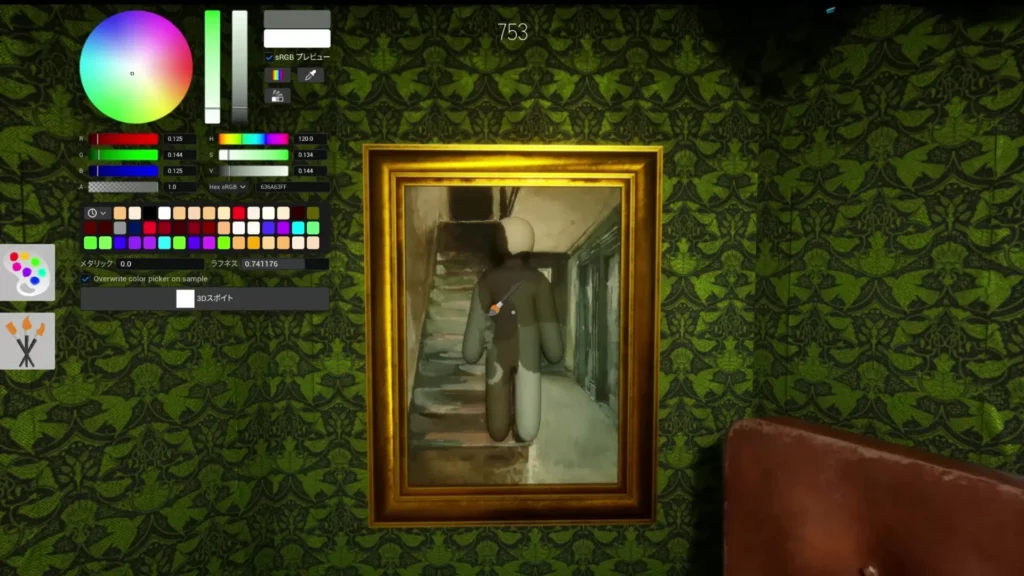
A skilful player might reproduce the colours and patterns of a wall closely enough to disappear against it. Another might produce a hopelessly inaccurate disguise but choose such an audacious location that the Seekers repeatedly overlook it. A carefully prepared hiding place can be ruined by a tap of a movement key when a Seeker is nearby.
These possibilities make the game easy to understand but difficult to predict. The rules remain largely unchanged from one round to the next. What happens within them depends on the ingenuity, mistakes and reactions of the people playing.
That distinction is central to Meccha Chameleon’s appeal.
How Meccha Chameleon Turns Play Into Stories
In our recent No Latency research into games with unusually high lifetime playtime, we used the term “generative social systems” to describe one recurring form of engagement.
Generative social systems, according to our classification, describe games whose rules repeatedly bring players into unpredictable situations, creating tension, surprise and shared stories.
Meccha Chameleon provides an unusually clear example of this model. Its developers supply the roles, tools, environment and time limit, but much of the entertainment is produced by the players themselves.
Every round can create its own small drama. A Seeker becomes convinced that an innocent piece of scenery is another player. Someone remains hidden in an apparently impossible position. A convincing disguise is exposed when its player shifts position at the wrong moment. The rest of the group watches as a player walks past an obvious target several times without noticing it.
These incidents are not scripted and do not need to be particularly sophisticated. Their appeal comes from the gap between what the players know, what the Seekers suspect and what eventually happens.
The painting mechanic increases the range of possible outcomes because it allows for both creativity and imperfection. Even failure can be entertaining. A poor disguise may generate a better story than a technically accomplished one, particularly if it succeeds for reasons nobody can quite explain.
This gives Meccha Chameleon a renewable source of social material. Players are not simply completing content created in advance by the developers. They are continually creating new variations through their behaviour.
Why Meccha Chameleon Went Viral
The same quality that makes Meccha Chameleon entertaining within a group also makes it exceptionally effective on streams and social platforms.
Its premise can be understood almost immediately. A viewer sees an oddly painted figure attempting to disappear into the scenery while another player searches for it. No knowledge of the map, characters or wider game is required. Its bright, deliberately simple visual style makes the action immediately legible, even to viewers encountering the game through a short social clip.
The format also produces natural narrative arcs. A disguise is prepared. The Seeker approaches. The viewer can judge whether the hiding place is convincing and anticipate whether it will succeed. Discovery or escape then provides a clear conclusion.
This means that an individual round can work as a self-contained piece of entertainment outside the game. The player’s experience becomes a demonstration of the product.
Meccha Chameleon therefore performs three related functions at once. It creates an activity for the players, a story for the participating group and promotional material for an external audience.

The game’s other commercial advantages helped that material convert into sales. Its low price reduced the barrier between seeing a clip and buying the game. Hide-and-seek required little explanation. Its visual humour travelled readily between languages, while public matchmaking meant that buyers did not necessarily need to organise a complete group before playing.
The developers also made it straightforward for streamers to host matches involving viewers. This reduced the separation between spectators and participants, turning an audience into a potential player base.
HAGANEIRO has said that no money was spent on advertising the game before its success. That does not mean marketing played no part in its rise. Rather, much of the marketing was generated by the design itself.
Meccha Chameleon did not merely give streamers a product to promote. It gave them a reliable way to produce entertaining material.
Meccha Chameleon Sales and Player Count Tell Different Stories
The results were immediate. Meccha Chameleon sold 500,000 copies within two days, one million within four days and three million within a week. It reached approximately 15 million sales in its first 25 days. The developers announced these successive milestones through the game’s Steam news feed.
Sales continued after the initial explosion, but at a slower rate. The game required another 37 days to add the next five million and reach 20 million.
Its concurrent player count followed a more pronounced curve. Meccha Chameleon reached a launch-day peak of approximately 20,700 players on Steam. That figure continued rising as the game spread, reaching an all-time high of 340,534 on 21 June.
The monthly peak fell to approximately 141,600 in July and 31,400 in August, according to hourly Steam observations compiled by Raijin. At the time of writing, its recent 24-hour peak was closer to 12,000. August’s highest figure was therefore about 91 per cent below the June record.
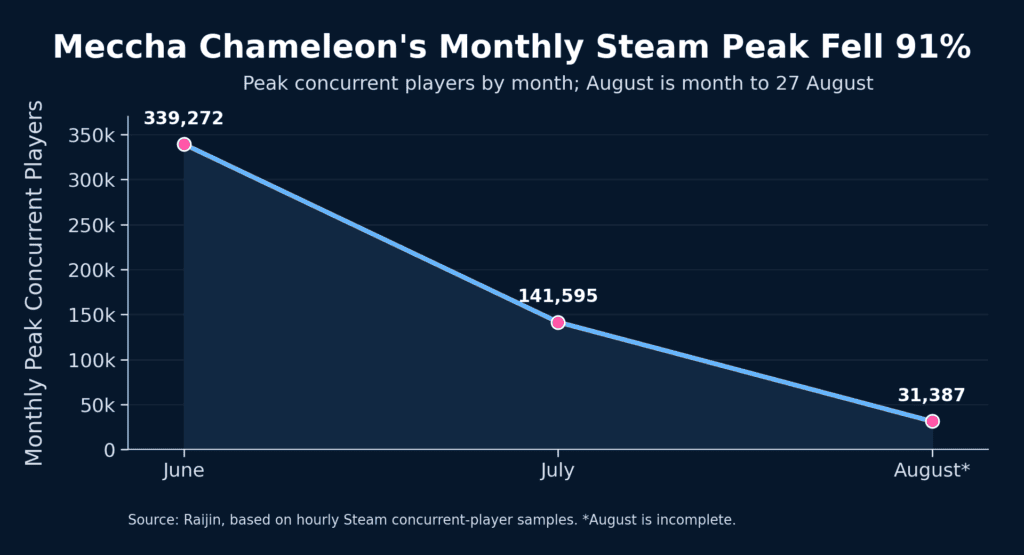
These figures need to be interpreted carefully. A dramatic fall from an exceptional viral peak is not unusual, particularly for a game that arrived with such speed. Concurrent users do not represent everybody who continues to play, and a party game may be opened occasionally with friends rather than used as a daily habit.
An audience of several thousand concurrent players would also constitute a substantial success for most independent developers. Meccha Chameleon has received tens of thousands of positive Steam reviews and continues to attract a meaningful active population.
Nor does declining engagement undo the commercial achievement. Meccha Chameleon is primarily a low-cost premium purchase rather than a free-to-play service dependent on years of player spending. Having sold 20 million copies, it does not need to maintain its launch audience to qualify as an extraordinary success.
Nevertheless, the contrast between sales and concurrent participation raises an important question. The system that persuaded millions of people to try Meccha Chameleon may not provide equally strong reasons for them to remain.
Can Meccha Chameleon Maintain Its Popularity?
Meccha Chameleon allows room for improvement and mastery. Players can become better at matching colours, identifying promising locations, choosing poses and detecting subtle inconsistencies in the environment.
But the game offers relatively few forms of investment beyond the immediate round. A disguise disappears when the match ends. Players are not cultivating a persistent world, developing a character over a long period or building a collection that carries significant personal meaning. The visual setting is distinctive, but the principal attraction is what people do within it rather than the desire to inhabit that world.
This does not make the design deficient. Its simplicity is part of what made the game accessible, legible and easy to share. It does, however, leave much of its appeal dependent on the continuing ability of the central mechanic to produce fresh surprises.
No Latency’s earlier engagement research suggested that many durable games give players several different reasons to return. Competition might sit alongside creativity, long-term ownership, persistent consequences or attachment to a fictional world. If one source of engagement weakens, another can continue to support the experience.
Comparisons with Phasmophobia
Phasmophobia, another Steam game analysed in depth as part of our Engagement series, provides a useful comparison. Its unpredictable social encounters are reinforced by a deeper game of deduction, in which players learn to identify different ghosts using evidence, equipment and clues in their behaviour. Progression, varied locations and difficulty settings provide further reasons to return. Meccha Chameleon also generates memorable stories, but currently offers fewer layers of mastery and long-term investment once its central comic possibilities become familiar.
Meccha Chameleon is therefore perhaps more concentrated. It has one extraordinarily productive social system, supported by a modest layer of mastery, but fewer secondary structures to sustain interest once players feel familiar with its comic possibilities.
It has an exceptional engagement engine, but perhaps not yet an engagement ecosystem.
How the Game Could Keep Players Coming Back
The developers have already taken steps to widen those possibilities. Post-launch updates have added maps, modes, proximity voice chat and other features. Steam Workshop support allows players to create and distribute their own environments, while collaborations can provide new settings and renewed visibility.
These additions matter most when they deepen the interactions that made the game successful. A new map does more than provide different scenery if it creates new camouflage problems and new opportunities for deception. A new mode can alter the relationships between players and produce situations that the original rules did not allow.
Workshop support may be particularly important because it gives part of the community a more persistent creative role. Instead of producing a disguise that vanishes after one round, players can build environments used by other groups.
The obvious alternative would be to add more conventional retention mechanics, such as extensive progression systems, unlocks or recurring rewards. But that approach carries its own risk. Additional complexity could weaken the immediacy that allowed viewers to understand Meccha Chameleon within seconds.
The developers’ challenge is therefore not simply to add more content. It is to expand the game’s range of possible stories without obscuring the simple premise responsible for its reach.
What Meccha Chameleon’s Success Means for Developers
Meccha Chameleon will inevitably encourage other developers to pursue inexpensive, streamer-friendly multiplayer games. Its success should not be treated as proof that this is an easily reproducible formula.
Many simple party games provide amusing interactions. Far fewer create situations distinctive enough to entertain people outside the participating group. Low prices and streamer exposure can amplify demand, but they cannot manufacture an inherently watchable experience.
Meccha Chameleon succeeded because its central mechanic connects player creativity, social unpredictability and visual communication. The rules generate moments worth sharing, and those moments explain the game more effectively than a conventional advertisement could.
That helps account for its extraordinary rise. Its subsequent player decline points to the possible limits of the same concentrated design.
Meccha Chameleon has shown how far one powerful generative social system can travel. Its longer-term challenge is to give players more reasons to remain without sacrificing the simplicity that allowed it to spread.