Decoding the digital age
What Is iGaming? Inside the Global Online Gambling Industry
Inside the global iGaming industry: its products, major companies, revenue sources, regulatory pressures and the human cost of gambling moving online.

Games and Online Gambling
What Is iGaming? Inside the Global Online Gambling Industry
Inside the global iGaming industry: its products, major companies, revenue sources, regulatory pressures and the human cost of gambling moving online.
In a Word...
- iGaming encompasses online casino, sports betting, poker and a large supporting network of technology and data suppliers.
- The online casino sector leads many established markets, with slots generating a particularly large share of industry revenue.
- Mobile access has powered rapid growth while intensifying concerns about gambling harm, consumer protection and regulation.
Gambling was once closely tied to physical places and particular occasions. A customer visited a casino, entered a betting shop or went to a racecourse. Today, the same activities can be accessed through a smartphone at almost any time and from almost anywhere that permits them.
This digital market is commonly known as iGaming. It encompasses online casinos, sports betting, poker, bingo and other forms of real-money wagering conducted over the internet. Around the consumer-facing brands sits a much larger network of game developers, technology platforms, payment companies, data suppliers, affiliates and regulatory services.
The industry has grown into one of the largest parts of the digital entertainment economy. It has produced multinational operators with billions in annual revenue, turned casino games into continuously updated software products and encouraged governments around the world to reconsider gambling laws written before the arrival of the smartphone.
It has also attracted considerable controversy. Questions about gambling harm, advertising, money laundering and the use of behavioural data have made regulation a defining feature of the market. To understand iGaming, it is therefore necessary to look not only at what people play, but at the business and regulatory systems operating behind every bet.
What is iGaming?
iGaming means gambling conducted through the internet or another electronic communications network. The “i” is generally understood to stand for “internet”, although “interactive gaming” is also sometimes used.
Its principal product categories are:
- Online casino games, including slots, roulette and blackjack
- Live casino games streamed from studios with human dealers
- Sports and event betting
- Online poker
- Bingo
- Lotteries and instant-win games
- Newer formats such as crash games, virtual sports and esports betting
The definition is not applied consistently everywhere. In Europe, iGaming is often used as an umbrella term for most forms of online gambling. In the United States, industry reports commonly use “iGaming” to mean online casino gaming specifically, with sports betting treated as a separate category. This difference partly explains why published estimates of the industry’s size can appear to contradict one another.
iGaming should also be distinguished from online gaming. A conventional multiplayer video game may involve online competition, subscriptions or in-game purchases, but it is not ordinarily classed as iGaming unless players are wagering money or something of monetary value.
The boundary is becoming harder to police. Loot boxes and other randomised purchases can reproduce some of the mechanics of gambling without offering a conventional cash prize. As No Latency explored in its examination of loot boxes and European games regulation, regulators increasingly have to decide when monetised play begins to resemble gambling closely enough to warrant similar protections.
From Online Poker to Mobile Casino
The commercial roots of iGaming stretch back to the 1990s, when the spread of home internet connections made it possible to offer casino games and take bets remotely. Early operators were often based in small offshore jurisdictions, serving customers across borders before most large countries had developed specific laws for online gambling.
Poker became one of the first products to demonstrate the internet’s potential. Rather than playing against the house, players competed against one another while the platform collected a fee known as the rake. The largest sites brought participants from multiple countries into common pools, ensuring that games were available at different stakes around the clock.
This created one of the internet’s earliest borderless digital marketplaces. It was also dependent on uncertain legal arrangements and a complex network of banks and payment processors.
Online Poker’s Black Friday
That vulnerability became clear in April 2011, when US authorities seized the domains of PokerStars, Full Tilt Poker and Absolute Poker and unsealed indictments against executives associated with the companies. The intervention, remembered within poker as Black Friday, removed American players from the largest international platforms and fractured the liquidity on which the market depended.
The episode did not eliminate online poker, but it ended the industry’s first lightly regulated era. Full Tilt collapsed after investigators found that it lacked sufficient funds to repay customers, while PokerStars survived, settled with the US authorities and eventually acquired its former rival. The full story is examined in The Great Online Poker Bust.
In the years that followed, the industry increasingly moved towards nationally or regionally licensed markets. At the same time, smartphones removed much of the remaining friction from online gambling. Customers no longer needed to sit at a computer or download specialist poker software. A casino, sportsbook or bingo room could be carried in a pocket.
Mobile is now the industry’s dominant distribution channel. According to the European Gaming and Betting Association, mobile devices generated 58% of European online gambling revenue in 2024, up from 56% a year earlier.
What are the Main Parts of the iGaming Market?
Although iGaming products are frequently offered through the same account, they have different economics and patterns of use.
Online Casino
Online casinos offer digital versions of familiar casino products, including slots, roulette, baccarat and blackjack. The operator may develop some content itself, but most casino sites assemble libraries of games from numerous specialist studios.
Slots are particularly important because they are simple to distribute, require no live event or opposing player, and can be played continuously. Thousands of titles can sit within the same platform, differentiated by their themes, visual presentation, volatility, bonus features and return-to-player rates.
Live Casino
Live casino combines digital distribution with human dealers operating from purpose-built studios. Players watch a video stream while placing bets through an on-screen interface.
The format was initially designed to reproduce roulette, blackjack and baccarat, but it has expanded into elaborate game-show products created specifically for online audiences. These studios require substantial physical and technical infrastructure, creating a barrier to entry that has helped a relatively small number of suppliers establish strong positions.
Sports Betting
Sportsbooks take bets on the outcome of matches, races and other events. Their economics are influenced by the volume wagered, the odds offered and the actual results.
This makes revenue less predictable than in online casino. A run of results favouring customers can materially affect quarterly performance. Operators have sought to improve margins through products such as accumulators and same-game multiples, which allow several outcomes to be combined within one bet.
Poker
Online poker is primarily a player-to-player market. The platform normally earns a percentage of each pot or charges entry fees for tournaments rather than betting directly against its customers.
Its most important commercial resource is liquidity. Players will gravitate towards platforms that have enough participants to provide a wide range of games, stakes and tournaments. That creates powerful network effects, but also makes poker markets vulnerable when regulation separates players into different national pools.
Other Products
Bingo, lotteries and instant-win games remain significant in certain markets. Newer products include crash games, in which a multiplier rises until an unpredictable stopping point, and virtual sports generated by software rather than played by human competitors.
The precise legal classification of these products varies. A format accepted as regulated gambling in one country may be prohibited, restricted or placed in a different category elsewhere.
How Does the iGaming Ecosystem Work?
The betting brand is only the most visible part of a layered industry.
Operators such as FanDuel, bet365 and Ladbrokes hold customer relationships and, in regulated markets, the relevant licences. They manage deposits and withdrawals, market their products, monitor player behaviour and decide which games or betting markets to offer.
Behind them are platform providers responsible for player accounts, wallets, content management and back-office systems. Game aggregators allow an operator to connect to many casino studios through a single technical integration, avoiding the need to build a separate connection for every supplier.
Sportsbooks require odds, live data and risk-management systems. Payment providers process deposits and withdrawals, while identity and compliance specialists conduct age verification, anti-money-laundering checks and fraud detection. Affiliates and comparison sites direct customers towards operators in return for an initial fee, an ongoing share of revenue or a combination of the two.
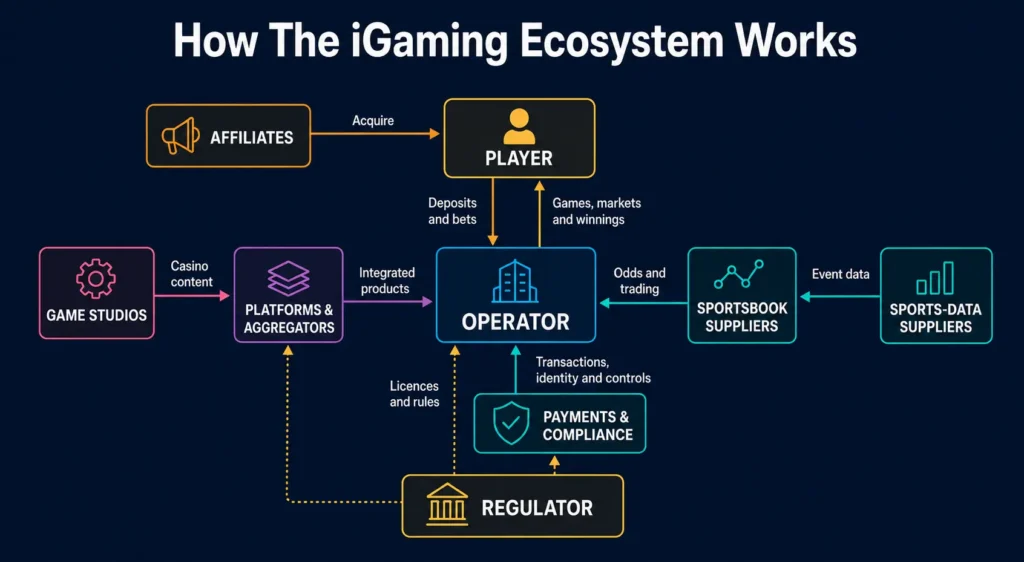
The result is a complex B2B market operating beneath the B2C brands. Two online casinos that appear to be competitors may use games from the same studios, run on related platform technology and depend on the same payment or data providers.
Some operators own more of this infrastructure than others. Vertical integration can provide greater control over customer data, pricing and product development. Smaller brands can instead acquire much of what they need from external suppliers, reducing the cost and time required to enter a market.
How Big is the iGaming Industry?
There is no single definitive estimate of the global market. Published figures may measure the total amount wagered, the money retained after winnings or the revenue of particular platforms and suppliers. Some include lotteries, while others exclude them. Unlicensed and offshore gambling is particularly difficult to measure.
Regional regulatory data provides a more reliable picture.
Europe’s gambling market generated €123.4 billion in gross gaming revenue in 2024, according to the European Gaming and Betting Association. Online gambling accounted for €47.9 billion, or 39% of the total, compared with 37% a year earlier.
In Great Britain, remote casino, betting and bingo generated £7.8 billion in gross gambling yield during the year to March 2025, according to the UK Gambling Commission.
The US market uses narrower terminology. In 2025, state-regulated sports betting generated $16.96 billion in revenue on $166.94 billion wagered. Online casino, reported as iGaming, generated a further $10.74 billion, an increase of 27.6% from the previous year. This growth is notable because full online casino remains legal in far fewer states than sports betting.
Several measurements are used to describe these markets:
- Handle or stakes is the total amount wagered by customers.
- Gross gaming revenue, or GGR, is the amount wagered minus winnings returned to players.
- Gross gambling yield, or GGY, is a closely related term used by the British regulator.
- Net gaming revenue, or NGR, deducts specified costs from GGR, although companies do not all calculate it in the same way.
- Hold describes the proportion of stakes retained by a sportsbook.
A sportsbook can therefore accept billions in bets without generating anything close to that amount in revenue.
Where Does iGaming Revenue Come From?
Sports betting attracts much of the media attention surrounding iGaming. It is attached to major competitions, clubs and broadcast events, and its advertising is highly visible. In many established online markets, however, casino games generate more revenue.
Of Europe’s €47.9 billion in online gambling revenue during 2024, online casino accounted for €21.5 billion. Online sports and event betting generated €13.7 billion, with the remainder coming from lotteries, poker, bingo and other products.
Quick answer
How Do iGaming Companies Make Money?
- Casino operators earn revenue from the mathematical house advantage built into their games.
- Sportsbooks incorporate a margin into their odds, while poker platforms generally collect a rake or tournament fee.
- Gross gaming revenue is not profit. Operators must cover duties, licence fees, supplier shares, affiliate commissions, payments, promotions, technology, customer service and compliance.
- Scale matters. Operators often spend heavily to acquire customers in new markets before shifting towards retention, personalised promotions and cross-selling.
- Product mix also matters. Flutter generated approximately $16.4bn in 2025, including $7.2bn from iGaming across its international and US divisions. Casino revenue can be continuous and relatively predictable, but its third-party content costs can be higher than those of sportsbook, according to Flutter’s 2025 annual report.
The difference is still clearer in Great Britain. Of the £7.8 billion generated by remote casino, betting and bingo in the year to March 2025, online casino provided £5 billion. Slots alone contributed £4.2 billion. Remote betting generated £2.6 billion, led by football at £1.3 billion and horse racing at £766.7 million.
Casino products have several commercial advantages. They are available continuously, are not dependent on a sporting calendar and can offer repeated rounds of play within a short period. Sports betting can be an effective way to attract customers, but operators frequently seek to introduce those customers to casino games that can be played between fixtures and throughout the year.
Sportsbook revenue is also affected by results. Flutter reported that its US sportsbook generated a net revenue margin of 8.6% in 2025, with shifts in sporting outcomes influencing the figure. Casino games have mathematically defined returns over large numbers of plays, making their aggregate revenue less vulnerable to an afternoon on which several heavily backed teams all win.
Who are the Major iGaming Companies?
The industry’s leading companies can be divided into several groups.
Consumer-Facing Operators
Flutter Entertainment is the largest and most geographically diversified operator, with major positions in the US, UK, Ireland, Italy and Australia. Its collection of brands spans sports betting, casino, poker and lotteries.
bet365 remains one of the most important privately owned operators, with a particularly strong sportsbook business. Entain owns brands including Ladbrokes, Coral and bwin, as well as half of the BetMGM joint venture. Entain reported £5.33 billion in net gaming revenue for 2025, excluding its share of BetMGM.
DraftKings and FanDuel dominate much of the regulated US sportsbook market, while BetMGM is a major competitor in states that permit online casino. Other significant groups include Betsson, FDJ United and Kaizen Gaming, the company behind Betano.
Game and Platform Suppliers
Evolution is the leading supplier of live casino products and also owns slots businesses including NetEnt and Big Time Gaming. The company supplies more than 870 operators and employs over 22,000 people across studios in Europe, Asia and the Americas.
Pragmatic Play, Light & Wonder, Play’n GO and Games Global are among the other major casino-content suppliers. Playtech operates across casino games, platforms and sportsbook technology, while EveryMatrix supplies modular casino, sports and account-management systems.
Kambi and OpenBet provide sportsbook technology, trading and related services. Sportradar and Genius Sports occupy another strategically important layer, collecting and distributing sports data while also supplying betting and integrity products.
Affiliates and Marketing Businesses
Affiliates acquire customers through search results, comparison sites, reviews, news and specialist sports content. Better Collective and Gambling.com Group are among the largest publicly listed companies built around this part of the market.
The relationship is commercially important but controversial. Affiliates can help customers compare licensed operators, but poorly controlled marketing can also obscure risks, promote offshore sites or present gambling content as independent advice.
| Layer | What It Does | Illustrative Companies |
|---|---|---|
| Operators | Acquire customers, hold licences and accept bets. | Flutter, bet365, Entain, DraftKings, BetMGM, Betsson, FDJ United and Kaizen Gaming |
| Game Studios | Develop slots, table games and live casino products. | Evolution, Pragmatic Play, Play’n GO, Games Global and Light & Wonder |
| Platforms And Aggregators | Connect operators to games, wallets, accounts and back-office systems. | Playtech, EveryMatrix, OpenBet and SOFTSWISS |
| Sportsbook Suppliers | Supply odds, trading and sportsbook technology. | Kambi, OpenBet and Altenar |
| Sports-Data Suppliers | Distribute live data, pricing and integrity services. | Sportradar and Genius Sports |
| Payments And Compliance | Handle deposits, identity checks, fraud and anti-money-laundering controls. | Numerous specialist providers |
| Affiliates | Acquire players through search, comparison sites and media. | Better Collective and Gambling.com Group |
Why is iGaming so Heavily Regulated?
Gambling regulation generally pursues three objectives: keeping gambling fair, preventing its use in crime and protecting children and vulnerable adults.
Licensed operators must verify customers’ identities and ages, monitor suspicious transactions and demonstrate that games operate according to approved rules. Regulators may also impose requirements concerning advertising, customer funds, deposit limits, game design and intervention when behaviour indicates possible harm.
These obligations differ considerably between jurisdictions. The US regulates online gambling primarily at state level. European countries maintain separate national licensing systems, even though operators and suppliers may work across the continent. Other jurisdictions prohibit most online gambling or allow offshore companies to serve customers under uncertain legal arrangements.
Taxation can have a decisive effect on the market. In April 2026, Britain increased Remote Gaming Duty on remote gaming profits (broadly stakes received minus winnings paid) from 21% to 40%. A new 25% duty on most remote betting is scheduled to take effect in April 2027. The UK government said the larger increase for remote casino reflected both its lower operating costs and the greater harms associated with products such as online slots.

This is a genuine regulatory dilemma. A licensed market can provide consumer protections and tax revenue, but regulation is effective only if customers continue to use it. At the same time, the threat of an illegal market can become a convenient argument against almost any restriction placed on legal operators.
The industry argues that taxes and restrictions can reach a point at which licensed operators cannot compete effectively with unregulated alternatives. If legal sites offer less attractive odds, fewer promotions or more intrusive checks, some customers may move to offshore platforms with weaker safeguards.
The Human Cost of Online Gambling
Most people who gamble do not develop a gambling disorder. For those who do experience harm, however, the consequences can extend far beyond the money lost.
The World Health Organization cites estimates suggesting that 1.2% of the world’s adult population has a gambling disorder. It also reports that people gambling at harmful levels generate around 60% of industry losses, although global estimates remain limited and measurement methods vary. Associated harms can include financial distress, relationship breakdown, mental illness, suicide, crime and the diversion of household spending away from essentials.
Online gambling changes the circumstances in which these risks arise. A physical casino or betting shop has opening hours, travel requirements and moments at which the customer naturally leaves. A mobile product can be available continuously and privately, with deposits made in seconds and new betting opportunities appearing throughout the day.
Online slots have received particular attention because of their speed and repetitive structure. Many use variable-ratio reinforcement, in which rewards arrive unpredictably and encourage the behaviour to continue. Near misses, audiovisual feedback and the possibility of a larger win can maintain attention even when the player is losing overall. No Latency has examined the wider use of this behavioural model in The Great Game of Monetization.
The Double-Edged Role of Player Data
Operators now collect detailed information about when customers play, which offers they accept, how their stakes change and whether they return after losing. This data can be used to improve products and personalise promotions. It can also be used to identify unusual deposits, long sessions, escalating losses and other possible indicators of harm.
The same analytical capability can therefore support opposing outcomes. A system can prompt a customer to take a break or place a limit on their account. It can also determine which promotion is most likely to bring that customer back.
Licensed operators provide deposit controls, time-outs, self-exclusion systems and other safer-gambling tools. They are also required to intervene in particular circumstances. Nevertheless, the UK Gambling Commission continues to impose penalties for failures involving anti-money-laundering procedures and the treatment of vulnerable customers.
The underlying conflict is difficult to remove. Operators are expected to identify and restrict damaging behaviour while running businesses whose revenue depends on customers continuing to gamble and lose money. Regulation can change the balance of those incentives, but it cannot eliminate them entirely.
What Comes Next for iGaming?
Further growth is likely to come from a combination of new regulated markets and greater digital adoption within existing ones. Latin America has become a major focus following the introduction of regulated online betting in Brazil, while debate continues in US states that permit sports betting but not online casino.
Consolidation is also likely to continue. Large operators can spread technology and compliance costs across multiple markets, negotiate more favourable supplier agreements and cross-sell products through established brands. Suppliers with popular games or specialist infrastructure can earn revenue from many operators without taking on the full cost of acquiring customers.
Technology will continue to shape both the product and its oversight. Artificial intelligence can improve odds setting, detect fraud, personalise interfaces and identify patterns associated with harmful gambling. As elsewhere in the digital economy, the significance of the technology will depend on the objective it is instructed to pursue.
The relationship between licensed and illegal gambling will remain equally important. Governments want the tax revenue and consumer oversight that regulation provides, while operators want rules that allow them to compete. The result is unlikely to be a single global system. iGaming will remain an international technology industry governed through a shifting patchwork of national laws.
In Summary
iGaming is the online branch of the gambling industry, encompassing casino games, sports betting, poker, bingo, lotteries and related products. Its growth has created a substantial digital ecosystem extending from consumer brands to game studios, platform providers, payment companies, data suppliers and affiliates.
Online casino is its largest revenue source in many established markets, with slots providing a particularly large share. Sports betting remains commercially and culturally important, but casino products offer continuous play and revenue that is less dependent on the outcome of real-world events.
The industry’s scale and technical sophistication have made it an important part of the digital economy. They have also intensified longstanding questions about gambling harm, consumer protection, financial crime and the proper limits of commercial persuasion.
For iGaming companies, regulation is not simply an external obstacle. It determines which markets they can enter, which products they can offer, how they acquire customers and whether those customers trust them with their money. The modern industry has grown by placing gambling within immediate reach. Its future will depend in large part on how governments, companies and consumers respond to the consequences.